
Fibroadenoma: Symptoms, Causes, Diagnosis, and Treatment
Finding a breast lump can be frightening, but not all breast lumps are cancer. One of the most common noncancerous breast lumps is a fibroadenoma. These benign tumors often occur in younger women and typically feel smooth, firm, and easy to move beneath the skin.
Although fibroadenomas are not cancer, it’s important to have any new breast lump evaluated by a healthcare provider to confirm the diagnosis and rule out other conditions.
This guide explains what fibroadenomas are, their symptoms, how they are diagnosed, treatment options, and when to seek medical attention.
What Is a Fibroadenoma?
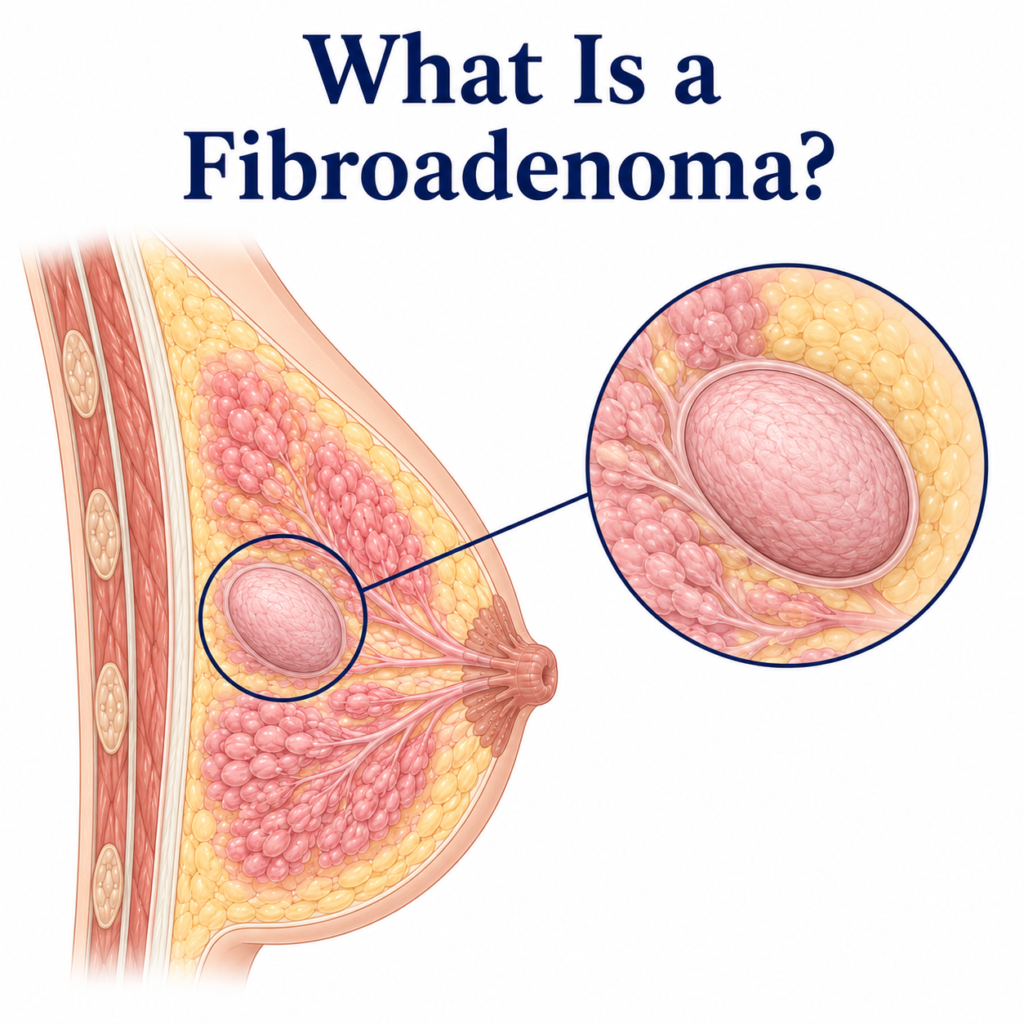
A fibroadenoma is a benign (noncancerous) breast tumor made up of both glandular and fibrous breast tissue.
Fibroadenomas:
- Are one of the most common benign breast masses.
- Usually occur in women between ages 15 and 35.
- May occur in one or both breasts.
- Can be single or multiple.
- Are not breast cancer.
Many remain stable for years, while others may slowly grow or even shrink over time.
What Causes Fibroadenomas?
The exact cause is unknown, but hormones—particularly estrogen—appear to play a role.
Fibroadenomas may:
- Develop during reproductive years
- Grow during pregnancy
- Increase in size with hormone therapy
- Shrink after menopause
What Are the Symptoms?
Many fibroadenomas cause no symptoms and are found accidentally during a breast self-awareness check, clinical breast exam, or imaging.
When symptoms occur, they may include:
- A painless breast lump
- A smooth, rubbery lump
- A round or oval shape
- A lump that moves easily under the skin (“breast mouse”)
- Mild tenderness before a menstrual period
Most fibroadenomas are between 1 and 3 cm in size, although some can become larger.
What Does a Fibroadenoma Feel Like?
Fibroadenomas often have characteristic features.
They are usually:
- Smooth
- Firm or rubbery
- Well-defined
- Easily movable
- Not attached to the skin
- Usually painless
These characteristics help distinguish fibroadenomas from some other breast masses, but imaging or biopsy is often needed for confirmation.
Who Is at Risk?
Fibroadenomas are more common in:
- Women younger than 35 years
- Adolescents and young adults
- Women with a family history of fibroadenomas
- Women using hormonal therapy
Can Fibroadenomas Become Cancer?
Most fibroadenomas do not increase the risk of breast cancer.
Simple fibroadenomas rarely become cancerous.
Certain complex fibroadenomas may be associated with a slightly increased risk of future breast cancer, particularly when other high-risk breast changes are present.
Your healthcare provider can explain your individual risk based on your pathology results and family history.
How Are Fibroadenomas Diagnosed?
After a clinical breast examination, your healthcare provider may recommend imaging.
Testing may include:
- Breast ultrasound (often the first test in younger women)
- Mammogram (more common in women age 40 and older or when appropriate)
- Breast MRI (selected cases)
- Core needle biopsy if imaging is inconclusive or the lump has suspicious features
A biopsy removes a small sample of tissue to confirm the diagnosis.
How Are Fibroadenomas Treated?
Treatment depends on the size of the fibroadenoma, your age, symptoms, imaging findings, and personal preference.
Observation
Many fibroadenomas do not require treatment.
Your healthcare provider may recommend:
- Periodic breast examinations
- Follow-up ultrasound
- Monitoring for changes in size
Observation is often appropriate for stable, biopsy-proven fibroadenomas.
Surgical Removal
Surgery may be recommended if:
- The lump continues to grow
- It becomes painful
- It is very large (often called a giant fibroadenoma)
- The diagnosis is uncertain
- Imaging or biopsy findings are concerning
- You prefer to have it removed
Minimally Invasive Procedures
In selected cases, minimally invasive procedures such as vacuum-assisted excision may remove a fibroadenoma without traditional surgery.
Not everyone is a candidate for these procedures.
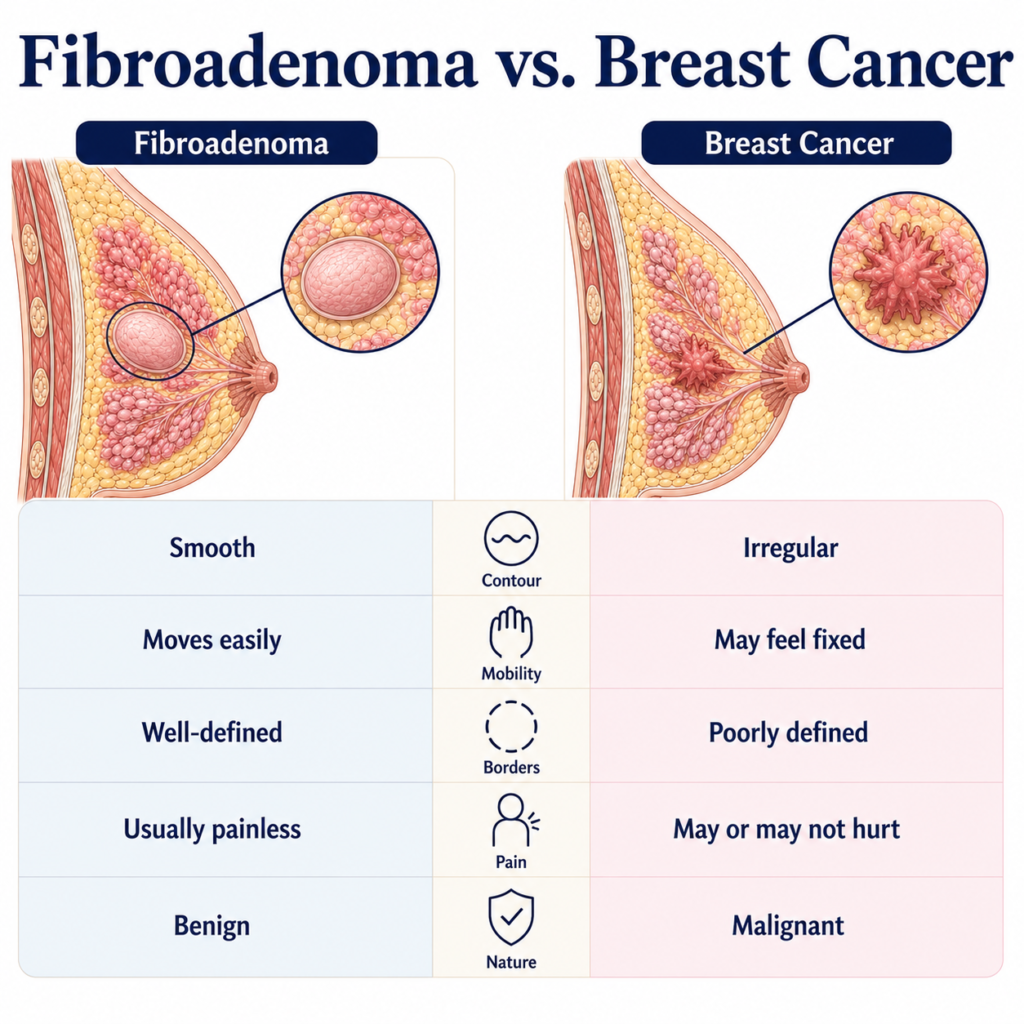
Although both can present as a breast lump, there are important differences.
| Fibroadenoma | Breast Cancer |
|---|---|
| Usually smooth | Often irregular |
| Easily movable | May feel fixed |
| Well-defined edges | May have poorly defined borders |
| Usually painless | May or may not be painful |
| Benign | Malignant |
A healthcare provider cannot reliably distinguish every lump by examination alone, which is why imaging is important.
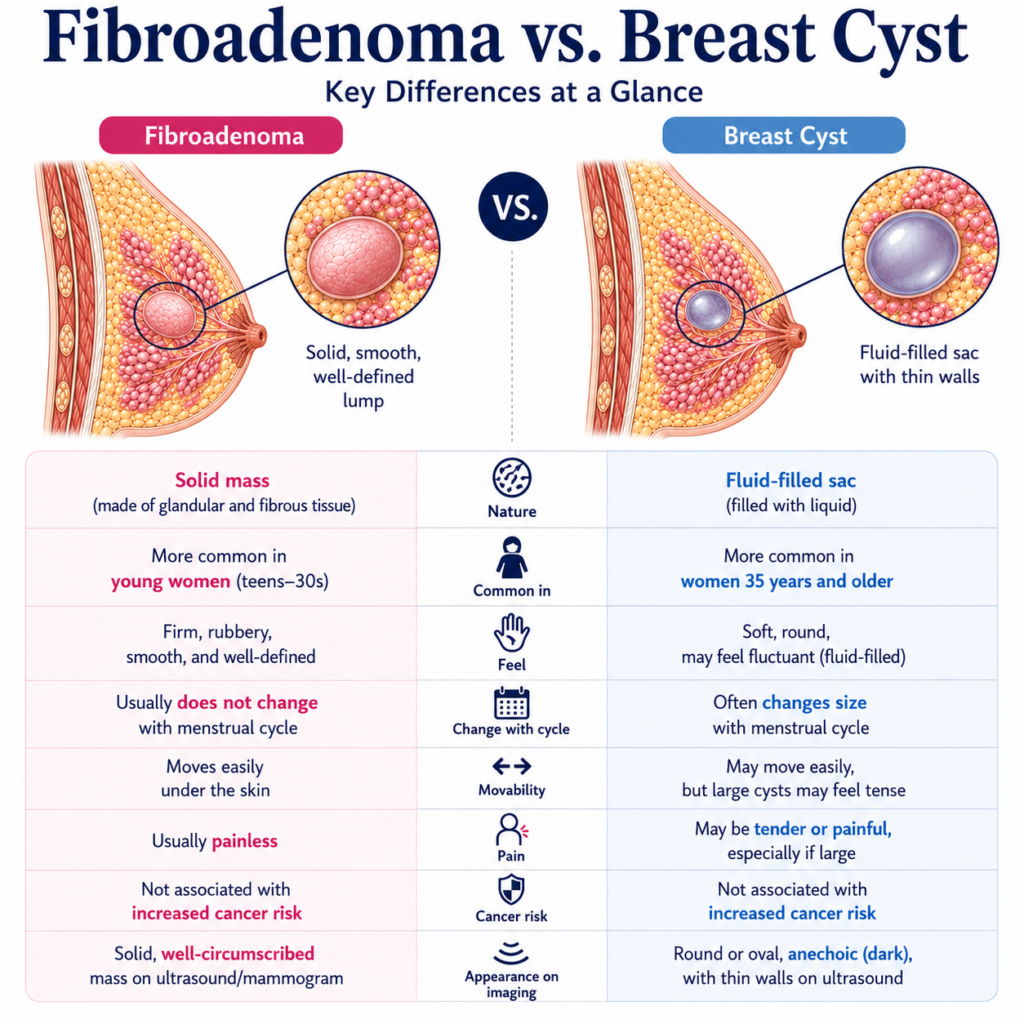
| Fibroadenoma | Breast Cyst |
| Solid | Fluid-filled |
| Firm or rubbery | Soft or tense |
| Does not collapse | May shrink after drainage |
| Seen on ultrasound as a solid mass | Appears as a fluid-filled sac |
Can You Prevent Fibroadenomas?
There is no known way to prevent fibroadenomas.
Maintaining a healthy lifestyle and participating in routine breast cancer screening based on your age and risk remain important.
When Should You See a Healthcare Provider?
Schedule an appointment if you notice:
- A new breast lump
- A lump that increases in size
- Breast pain that persists
- Skin dimpling
- Nipple discharge
- New nipple inversion
- Changes in breast shape
- Swollen lymph nodes under the arm
Even though many breast lumps are benign, every new lump should be evaluated.
When Is It an Emergency?
Fibroadenomas are not usually a medical emergency.
However, seek prompt medical care if you develop:
- Rapid breast swelling
- Severe breast pain with redness and fever
- Significant breast trauma
- A rapidly enlarging mass
- Signs of a breast infection
What Should You Do Next?
Discovering a breast lump can be stressful, but remember that fibroadenomas are one of the most common benign breast conditions. If you notice a new lump or any change in your breasts, schedule an evaluation with your healthcare provider. Early assessment with a breast exam and imaging can help determine the cause and provide reassurance or guide appropriate treatment if needed.
References
American College of Obstetricians and Gynecologists (ACOG). Diagnosis and Management of Benign Breast Disorders.
https://www.acog.org/clinical/clinical-guidance/practice-bulletin/articles/2016/06/diagnosis-and-management-of-benign-breast-disorders
American College of Radiology (ACR). Appropriateness Criteria®: Palpable Breast Masses.
https://acsearch.acr.org/docs/69495/Narrative/
American Cancer Society. Non-cancerous Breast Conditions.
https://www.cancer.org/cancer/types/breast-cancer/non-cancerous-breast-conditions.html
National Comprehensive Cancer Network (NCCN). NCCN Guidelines for Patients®: Breast Cancer Screening and Diagnosis.
https://www.nccn.org/patients/guidelines/content/PDF/breast-screening-patient.pdf
UpToDate. Fibroadenoma of the Breast. Wolters Kluwer.
https://www.uptodate.com