
Birth Control: Your Options, How They Work, and Choosing What Is Right for You
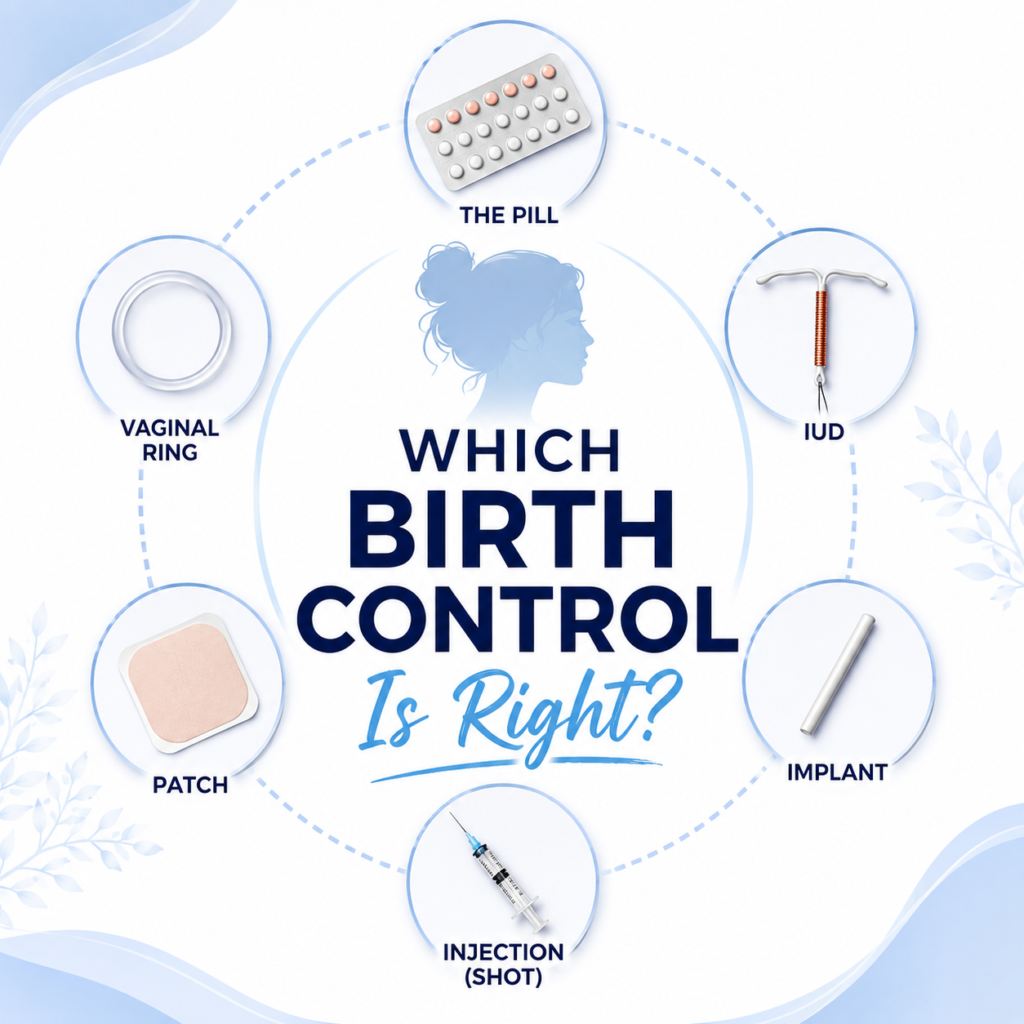
What Is Birth Control?
Birth control, also called contraception, includes medications, devices, and barrier methods that help prevent pregnancy.
Some methods also provide additional health benefits, such as:
- More regular periods
- Lighter menstrual bleeding
- Less painful cramps
- Improved acne
- Treatment of certain medical conditions like endometriosis or polycystic ovary syndrome (PCOS)
How Does Birth Control Prevent Pregnancy?
Different methods work in different ways.
Some:
- Stop your ovaries from releasing an egg (ovulation)
- Thicken cervical mucus so sperm cannot reach the egg
- Thin the lining of the uterus
- Block sperm from entering the uterus
Some methods use one of these approaches, while others use several at the same time.
Birth Control at a Glance
| Method | Typical Effectiveness | How Often You Use It |
|---|---|---|
| Implant | More than 99% | Every 3 years |
| Hormonal IUD | More than 99% | Every 3 to 8 years |
| Copper IUD | More than 99% | Every 10 years |
| Birth control shot | About 94% | Every 3 months |
| Birth control pill | About 93% | Every day |
| Patch | About 93% | Weekly |
| Vaginal ring | About 93% | Monthly |
| Condom | About 87% | Every time you have sex |
Hormonal Birth Control
Hormonal birth control contains estrogen, progestin, or both.
Common options include:
- Birth control pills
- Skin patch
- Vaginal ring
- Birth control shot
- Implant
- Hormonal IUD
These methods are highly effective when used correctly.
Lorem ipsum dolor sit amet, consectetur adipiscing elit. Ut elit tellus, luctus nec ullamcorper mattis, pulvinar dapibus leo.
Non Hormonal Birth Control
If you prefer to avoid hormones, options include:
- Copper IUD
- Male condoms
- Female condoms
- Diaphragm
- Cervical cap
- Spermicide
- Fertility awareness methods
Each method has different advantages and effectiveness.
Which Method Is Most Effective?
| Most Effective | Less Effective |
| Implant | Condoms |
| Hormonal IUD | Diaphragm |
| Copper IUD | Spermicide |
| Sterilization | Fertility awareness |
| Shot | Withdrawal |
Methods that require little daily effort are generally the most effective because there is less chance of forgetting to use them.
Did You Know?
The birth control pill does not protect against sexually transmitted infections (STIs). Condoms remain the best way to lower the risk of many STIs.
What Are the Benefits of Birth Control?
Depending on the method, birth control may:
| Possible Benefits |
| Prevent pregnancy |
| Make periods lighter |
| Reduce painful cramps |
| Improve acne |
| Treat heavy menstrual bleeding |
| Help manage endometriosis symptoms |
| Lower the risk of ovarian and endometrial cancer with some hormonal methods |
What Are the Possible Side Effects?
Side effects vary depending on the method.
Some people experience:
- Spotting between periods
- Breast tenderness
- Mild nausea
- Headaches
- Mood changes
- Changes in menstrual bleeding
Many side effects improve after the first few months.
Lorem ipsum dolor sit amet, consectetur adipiscing elit. Ut elit tellus, luctus nec ullamcorper mattis, pulvinar dapibus leo.
Myths vs. Facts
| Myth | Fact |
| Birth control causes infertility. | Fertility usually returns after stopping most methods. |
| You need to take breaks from birth control. | There is no medical reason for routine breaks. |
| Birth control pills protect against STIs. | Only condoms help reduce the risk of many sexually transmitted infections. |
| Birth control always causes weight gain. | Most methods do not cause significant weight gain for most people. |
| You cannot get pregnant the first time you have sex. | Pregnancy is possible anyti |
Frequently Asked Questions
Can birth control affect future fertility?
For most methods, fertility returns soon after stopping. Some people who receive the birth control shot may experience a longer delay before fertility returns.
Can I skip my period with birth control?
Many hormonal methods can safely reduce or eliminate monthly periods. Talk with your healthcare provider about whether this is appropriate for you.
Which birth control is best?
There is no single “best” method. The right choice depends on your health, your goals, convenience, and personal preference.
References
Centers for Disease Control and Prevention. Contraception
https://www.cdc.gov/contraception/
American College of Obstetricians and Gynecologists. Birth Control FAQ
https://www.acog.org/womens-health/faqs/birth-control-faq
Office on Women’s Health. Birth Control Methods
https://www.womenshealth.gov/a-z-topics/birth-control-methods
World Health Organization. Family Planning and Contraception
https://www.who.int/news-room/fact-sheets/detail/family-planning-contraception