
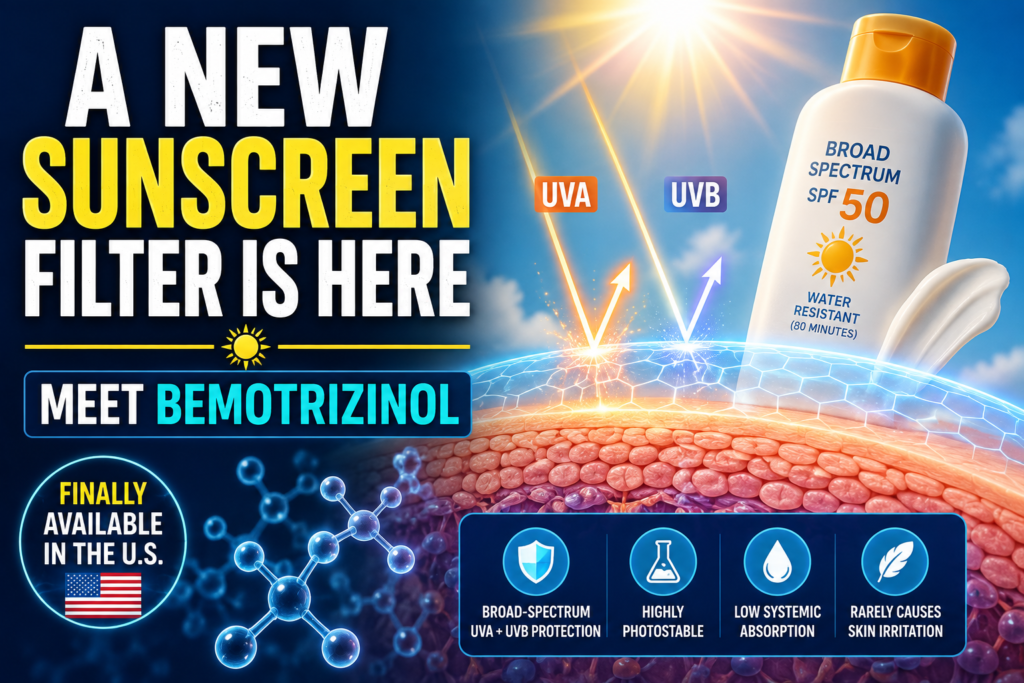
For decades, people shopping for sunscreen in Europe, Australia and parts of Asia have had access to ultraviolet filters that were not available in U.S. sunscreens.
That is finally beginning to change.
The U.S. Food and Drug Administration has added bemotrizinol, also known as BEMT, to the list of permitted active ingredients in over-the-counter sunscreens.
It is the first new sunscreen active ingredient added to the U.S. OTC sunscreen monograph since the late 1990s.
And now, sunscreens containing it are beginning to reach the U.S. market.
So what exactly is bemotrizinol, why has it taken so long to reach the United States, and does it mean you need to replace the sunscreen you already use?
What Is Bemotrizinol?
Bemotrizinol is an organic, or chemical, sunscreen filter that absorbs ultraviolet radiation before it can damage the skin.
You may also see it associated with names such as:
BEMT
Bis-ethylhexyloxyphenol methoxyphenyl triazine
Tinosorb S
PARSOL Shield
One of its biggest advantages is its ability to provide broad-spectrum protection.
That means it protects against both major types of ultraviolet radiation that affect the skin:
UVA rays penetrate more deeply into the skin and contribute to premature skin aging, wrinkles, pigmentation and skin cancer.
UVB rays are a major cause of sunburn and also contribute to skin cancer.
An effective sunscreen needs adequate protection against both.
Why Is Bemotrizinol Different?
Bemotrizinol has several properties that make it particularly useful in sunscreen formulations.
It Protects Against Both UVA and UVB
Bemotrizinol absorbs radiation across both the UVA and UVB portions of the ultraviolet spectrum.
That makes it useful for creating broad-spectrum sunscreens rather than targeting only a narrow range of UV radiation.
It Is Highly Photostable
Some sunscreen ingredients can gradually break down when exposed to sunlight.
Bemotrizinol is considered highly photostable, meaning it maintains its ability to absorb ultraviolet radiation well during sun exposure.
This property can also help stabilize other sunscreen ingredients when they are combined in a formulation.
Very Little Appears to Enter the Bloodstream
The FDA evaluated studies examining how much bemotrizinol is absorbed through the skin.
The available evidence showed low systemic absorption, meaning relatively little of the ingredient passes through the skin into the bloodstream.
This was one of the factors considered in the FDA’s safety evaluation.
Skin Irritation Appears Uncommon
The FDA’s review also found that bemotrizinol rarely causes skin irritation.
No sunscreen works perfectly for every person’s skin, but these characteristics contributed to the FDA’s determination that bemotrizinol can be considered generally recognized as safe and effective when used according to the conditions established in the sunscreen monograph.
Is Bemotrizinol Actually New?
The ingredient is new to FDA-authorized U.S. sunscreens, but it is not a newly invented sunscreen filter.
Bemotrizinol has been used internationally for many years.
Europe approved the ingredient in 2000, and it has also been used in sunscreens sold in Australia, Asia and other markets.
American consumers who purchased international sunscreens may therefore already have used products containing it.
What is new is that manufacturers can now legally formulate qualifying U.S. OTC sunscreens with bemotrizinol under the FDA’s sunscreen monograph.
Why Did the United States Have Fewer Sunscreen Filters?
Sunscreens are regulated differently around the world.
In the United States, sunscreens are regulated as over-the-counter drugs.
That means active sunscreen ingredients must satisfy FDA requirements for safety and effectiveness before they can be marketed under the OTC sunscreen framework.
Other countries may regulate sunscreens differently, including as cosmetics or therapeutic products.
As sunscreen technology advanced internationally, the U.S. regulatory process did not add newer filters at the same pace.
As a result, American sunscreen manufacturers continued relying largely on a group of active ingredients that had been available for decades.
Bemotrizinol represents a significant change to that situation.
When Did the FDA Approve Bemotrizinol?
The FDA announced its final decision in June 2026.
The updated sunscreen monograph allowing bemotrizinol became effective on August 9, 2026.
The FDA permits bemotrizinol at concentrations of up to 6% in qualifying over-the-counter sunscreen products.
The agency determined that sunscreen products containing bemotrizinol under the specified conditions can be considered generally recognized as safe and effective.
Can Children Use Sunscreens Containing Bemotrizinol?
Under the FDA’s determination, bemotrizinol-containing sunscreens may be used in adults and children 6 months of age and older when products meet the applicable requirements.
For babies younger than 6 months, parents should generally rely primarily on sun avoidance, shade and protective clothing and discuss sunscreen use with a pediatric healthcare professional when necessary.
Are Bemotrizinol Sunscreens Available in the United States Yet?
They are beginning to arrive.
On August 31, 2026, Ultra Violette announced the U.S. launch of Unblock Screen SPF 50, described by the company as the first U.S. sunscreen formulated with the newly permitted filter.
Additional formulations are expected as manufacturers incorporate bemotrizinol into future U.S. sunscreen products.
This means American consumers should gradually begin seeing the ingredient appear on sunscreen labels.
Does Bemotrizinol Make Older Sunscreens Obsolete?
No.
This is an important point.
The arrival of a newer sunscreen filter does not mean your current sunscreen suddenly stopped working.
Existing broad-spectrum sunscreens can still provide excellent protection when used correctly.
The most effective sunscreen is often one that:
Provides broad-spectrum protection
Has SPF 30 or higher
Is water resistant when appropriate
Works well with your skin
Is comfortable enough that you will actually use it consistently
A technologically advanced sunscreen provides little benefit if you dislike it enough that you rarely apply it.
Mineral vs. Chemical Sunscreen: Where Does Bemotrizinol Fit?
Sunscreen ingredients are often divided into two broad categories.
Mineral sunscreens typically use zinc oxide or titanium dioxide.
Chemical or organic sunscreens use carbon-based compounds that absorb ultraviolet radiation.
Bemotrizinol belongs to the second category.
Neither category is automatically better for everyone.
Mineral sunscreens may work particularly well for some people with sensitive skin, while others prefer chemical sunscreens because they can be easier to formulate without a visible white cast.
The addition of bemotrizinol simply gives manufacturers another option for creating effective sunscreen formulations.
Does Better UVA Protection Matter?
Yes.
SPF primarily reflects protection against UV radiation that produces sunburn, particularly UVB.
But UVA exposure is also important.
UVA penetrates more deeply into the skin and contributes to:
Premature skin aging
Wrinkles
Hyperpigmentation
Loss of skin elasticity
DNA damage
Skin cancer
This is why dermatologists recommend choosing a sunscreen labeled broad spectrum rather than focusing only on the SPF number.
Bemotrizinol’s ability to absorb both UVA and UVB radiation makes it particularly useful for broad-spectrum formulations.
Do You Still Need to Reapply Sunscreen?
Absolutely.
A more photostable sunscreen ingredient does not eliminate the need for proper sunscreen use.
Sunscreen can still be removed by:
Swimming
Sweating
Toweling
Rubbing
Normal activity
The American Academy of Dermatology recommends applying a broad-spectrum, water-resistant sunscreen with SPF 30 or higher to exposed skin.
Sunscreen should generally be reapplied approximately every two hours when outdoors and after swimming or sweating according to the product’s directions.
Sunscreen Is Only Part of Sun Protection
Even excellent sunscreen should not be your only defense against ultraviolet radiation.
Additional protection includes:
Seeking shade
Wearing protective clothing
Wearing a wide-brimmed hat
Wearing UV-protective sunglasses
Limiting intense midday sun exposure when possible
No sunscreen blocks 100% of ultraviolet radiation.
Combining sunscreen with other protective measures provides better overall protection.
What Should You Do Next?
Bemotrizinol represents an important change in American sunscreen technology.
It provides broad UVA and UVB protection, is highly photostable, has low systemic absorption and has already been used internationally for many years.
Most importantly, its arrival gives sunscreen manufacturers another tool for developing products that may offer strong broad-spectrum protection while remaining comfortable enough for everyday use.
But you do not need to throw away your current sunscreen.
If you already use a broad-spectrum SPF 30 or higher sunscreen consistently, continue using it.
As bemotrizinol-containing products become more widely available, they will simply provide another option.
Because when it comes to preventing sun damage, premature skin aging and skin cancer, the best sunscreen is ultimately one that provides adequate protection and that you will use consistently.