
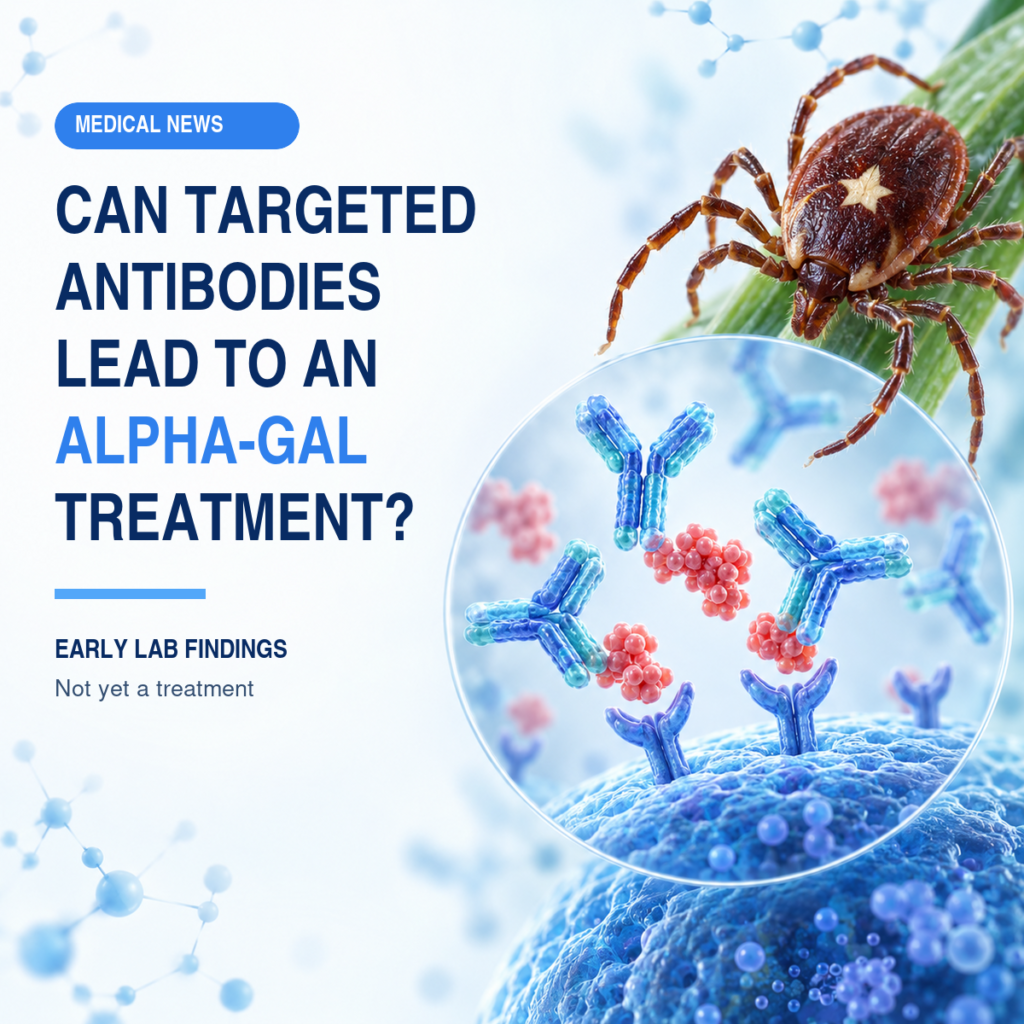
Could Targeted Antibodies Lead to a Treatment for Alpha-Gal Syndrome?
Laboratory findings reveal a promising research strategy, but no antibody treatment is available for patients yet.
A New Research Direction for a Difficult Allergy
Alpha-gal syndrome can make an ordinary meal feel unpredictable. Unlike many food allergies, reactions may begin several hours after exposure to mammalian meat or another product containing alpha-gal. That delay can make the connection between the exposure and symptoms difficult to recognize.
A newly published study in the Journal of Clinical Investigation describes human monoclonal antibodies that blocked allergy-driving antibodies from attaching to selected alpha-gal allergens in laboratory tests. One antibody also reduced activation of basophils, immune cells involved in allergic reactions.
The findings are scientifically important because they identify a possible way to interrupt the allergic process. They do not show that the antibodies prevent reactions in people, allow someone with alpha-gal syndrome to safely eat mammalian meat, or cure the condition. No alpha-gal-specific antibody treatment is currently approved.
What Is Alpha-Gal Syndrome?
Alpha-gal syndrome is a potentially serious allergy associated with tick bites. Alpha-gal, short for galactose-alpha-1,3-galactose, is a sugar molecule found in most non-primate mammals and in products derived from them. It can also be present in the saliva of some ticks.
After a tick bite, some people develop immunoglobulin E, or IgE, antibodies that recognize alpha-gal as a threat. Later exposure to alpha-gal can trigger an allergic reaction. Mammalian meat such as beef, pork, lamb, venison, or rabbit is a common source, but alpha-gal may also occur in dairy products, gelatin, certain medications, and other mammal-derived products.
Symptoms vary. They can include hives, itching, swelling, nausea, vomiting, abdominal pain, diarrhea, shortness of breath, dizziness, a drop in blood pressure, and anaphylaxis. Reactions often begin two to six hours after exposure, although timing and severity can differ from one episode to another.
Why Are Alpha-Gal Reactions Often Delayed?
The delayed pattern is one reason alpha-gal syndrome can be difficult to identify. Traditional food-allergy reactions often begin soon after a person eats the trigger. Alpha-gal reactions commonly occur later, sometimes during the night after an evening meal.
Researchers are still studying the exact reasons for this delay. Digestion and absorption of alpha-gal-containing fats and other molecules appear to influence when the immune system encounters enough allergen to trigger symptoms. The delay does not make the reaction less serious. Anyone with symptoms of anaphylaxis needs immediate emergency care.
What Did the Researchers Study?
The research began with a different question. Scientists were studying antibodies from people exposed to malaria and looking for antibodies that recognized alpha-gal on malaria parasites. They isolated 42 human monoclonal antibodies specific to alpha-gal.
Those antibodies did not bind strongly to the malaria parasite, so the team tested whether they might recognize allergens relevant to alpha-gal syndrome. The researchers examined whether the antibodies could bind selected alpha-gal-containing allergens and whether they could interfere with IgE from people with alpha-gal syndrome.
This was laboratory and translational research. It did not test an antibody drug in people, measure whether patients had fewer allergic reactions, or evaluate long-term safety.
What Did the Study Find?
Thirteen of the 42 antibodies bound to selected alpha-gal syndrome allergens, including angiotensin-converting enzyme, aminopeptidase N, and cetuximab.
Two antibody lineages blocked IgE from patients with alpha-gal syndrome from binding to two of the selected allergens in laboratory assays. Forms of one antibody, called AG028, also reduced allergen-driven activation of basophils that had been sensitized with patient serum.
Basophils are immune cells that can release substances involved in allergic inflammation. Reducing their activation in a laboratory assay suggests that the antibody interrupted part of the allergic signaling process. It is an encouraging mechanistic finding, not proof of clinical benefit.
Why Might Blocking IgE Matter?
IgE is central to many allergic reactions. In a sensitized person, allergen-specific IgE sits on the surface of immune cells. When an allergen connects with that IgE in the right way, the cells can release histamine and other mediators that produce symptoms.
An allergen-specific monoclonal antibody could theoretically act as a shield by occupying the allergen before the patient’s IgE can bind to it. The goal would be to interrupt the reaction at an early step rather than treating symptoms after immune activation has begun.
Related allergen-blocking antibody strategies are being studied for other allergies. Alpha-gal is especially challenging because it is a carbohydrate found on many different mammalian proteins and products. A future intervention may need to block a broad range of relevant alpha-gal-containing allergens.
Why This Is Not a Treatment Yet
Laboratory activity is only the beginning of treatment development. Before an antibody could become a therapy, researchers would need to determine whether it recognizes a sufficiently broad range of clinically important allergens, how long any protection lasts, what dose might be needed, and whether it is safe.
The study did not administer these antibodies to people with alpha-gal syndrome. It did not test food exposure, measure emergency reactions, or show that avoidance is no longer necessary. Laboratory assays also cannot fully reproduce digestion, absorption, immune responses, and the wide variety of exposures that occur in daily life.
The findings therefore support future research. They should not change a patient’s current avoidance plan or emergency plan.
What Should People With Alpha-Gal Syndrome Do Now?
Current care remains individualized. People with diagnosed alpha-gal syndrome should work with an allergist or another knowledgeable healthcare professional to identify which foods, medications, personal-care products, or other sources may need to be avoided.
Not everyone reacts to every alpha-gal-containing product, and the same person may have different reactions to similar exposures. That variability is one reason a personalized plan matters.
Preventing additional tick bites is also important because new bites may reactivate or worsen allergic sensitivity. Protective clothing, appropriate insect repellent, prompt tick checks, and attention to tick habitat can reduce exposure risk.
People who have been prescribed epinephrine should know when and how to use it. Using epinephrine for a severe reaction does not replace emergency evaluation.
When to Seek Emergency Care
Seek immediate emergency care for signs of a severe allergic reaction or anaphylaxis. Warning signs can include difficulty breathing, throat or tongue swelling, fainting, a marked drop in blood pressure, rapidly worsening symptoms, or symptoms involving more than one body system.
If epinephrine is used, emergency care is still necessary. Symptoms can recur, and additional monitoring or treatment may be needed.
What Comes Next?
The investigators identified a biological mechanism worth pursuing. Future studies will need to find antibodies with broader activity against alpha-gal allergens and evaluate their safety, dosing, durability, and effectiveness in people.
If the approach eventually succeeds, it could provide a targeted way to reduce allergic reactions. For now, that possibility remains a research goal rather than a clinical option.
The Bottom Line
Human monoclonal antibodies blocked patient IgE from binding to selected alpha-gal allergens in laboratory testing, and one antibody reduced basophil activation. These results may support the development of future interventions for alpha-gal syndrome.
The study was not a human treatment trial. It does not show that reactions can already be prevented in patients, that mammalian meat is safe, or that an antibody therapy is available. Current management still centers on individualized avoidance, prevention of additional tick bites, and preparation for allergic emergencies.
This content is for educational purposes only and is not a substitute for professional medical advice.
Sources and Further Reading
National Institutes of Health announcement
Journal of Clinical Investigation research article