
What Is Telehealth?
Healthcare has changed dramatically over the past decade. Today, many medical services can be delivered remotely using secure technology, making it easier than ever to connect with healthcare professionals without visiting a clinic.
This approach to care is known as telehealth.
Whether you’ve had a video visit, exchanged secure messages with your doctor, or used an online platform to receive medical care, you’ve likely experienced telehealth in some form.
What Is Telehealth?
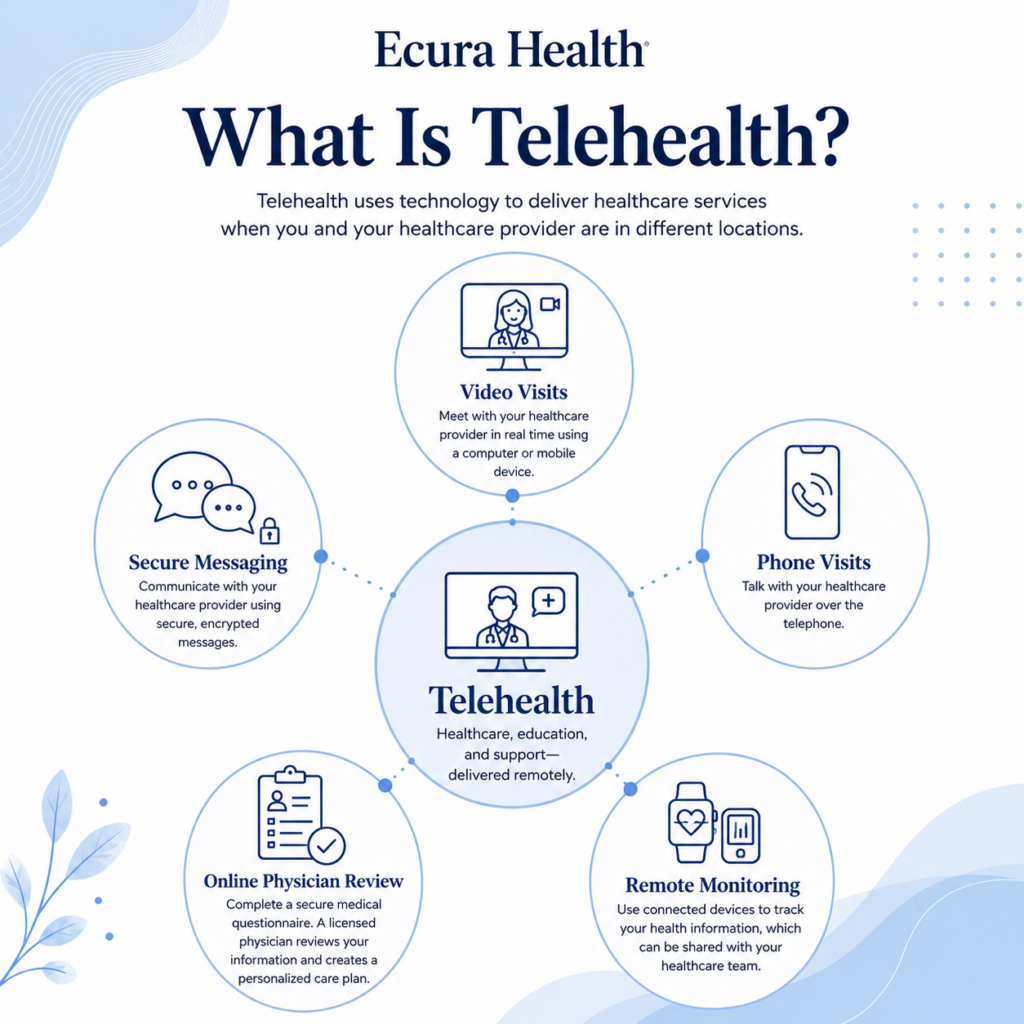
Telehealth is the use of digital communication technologies to deliver healthcare services, health education, and other health-related support when patients and healthcare professionals are in different locations.
Telehealth is a broad term that includes several ways of receiving care remotely, from live video appointments to secure messaging and remote monitoring.
Telehealth vs. Telemedicine
Although the terms are often used interchangeably, they are not exactly the same.
Telehealth is the broader term and includes:
- Remote medical care
- Health education
- Patient communication
- Remote monitoring
- Care coordination
Telemedicine refers specifically to the practice of providing medical care remotely through technology.
Think of telemedicine as one part of the larger telehealth ecosystem.
Common Types of Telehealth
Telehealth can take several forms depending on your healthcare needs.
Live Video Visits
A real-time appointment with your healthcare provider using a computer, tablet, or smartphone.
Telephone Visits
Some medical concerns can be evaluated through a scheduled phone conversation.
Secure Messaging
Patients and healthcare providers communicate using encrypted online messages rather than speaking live.
Online Physician Review
Patients complete a secure medical questionnaire that is reviewed by a licensed physician, who then develops a personalized care plan when appropriate.
This is the model used by Ecura Health for selected medical conditions.
Remote Patient Monitoring
Some patients use home devices, such as blood pressure monitors or glucose monitors, to securely share health information with their healthcare team.
Benefits of Telehealth
Telehealth offers many advantages for patients, including:
- Greater convenience
- Improved access to healthcare
- Reduced travel time
- More flexible scheduling
- Easier follow-up for many medical concerns
- Access to specialists who may be located far away
For many people, telehealth makes healthcare easier to fit into everyday life.
Is Telehealth Right for Every Situation?
Telehealth has become an important part of modern healthcare, but it is not intended to replace every type of medical visit.
Some health concerns are well suited for remote care, while others require an in-person examination, testing, or procedures. Healthcare providers determine the most appropriate approach based on each patient’s individual situation.
How Ecura Health Uses Telehealth
Rather than scheduling a live video or phone appointment, patients complete a secure medical questionnaire that is individually reviewed by a licensed physician. This approach allows us to provide convenient, physician-led care for carefully selected medical conditions while maintaining a thoughtful, personalized review process.
The Future of Telehealth
Telehealth continues to evolve as technology improves and healthcare becomes more connected.
From virtual visits and secure messaging to online physician review and remote monitoring, telehealth is expanding access to care while giving patients more options than ever before.
At Ecura Health, we believe technology should make healthcare more convenient without replacing the clinical judgment of a physician.
What Should You Do Next?
Whether you’re new to telehealth or have used it before, understanding the different ways healthcare can be delivered helps you choose the option that’s right for you. Explore our Health Guides to learn more about telehealth, common medical conditions, preventive care, and how digital healthcare continues to improve access for patients.
References
- U.S. Department of Health and Human Services (HRSA). What Is Telehealth?
https://www.hrsa.gov/telehealth/what-is-telehealth - Telehealth.HHS.gov. What Can Be Treated Through Telehealth?
https://telehealth.hhs.gov/patients/what-can-be-treated-through-telehealth - U.S. Department of Health and Human Services (HHS). What Is Telehealth? (HIPAA FAQ)
https://www.hhs.gov/hipaa/for-professionals/faq/3015/what-is-telehealth/index.html - MedlinePlus (U.S. National Library of Medicine). Telehealth.
https://medlineplus.gov/telehealth.html - Mayo Clinic. Telehealth: Technology Meets Health Care.
https://www.mayoclinic.org/healthy-lifestyle/consumer-health/in-depth/telehealth/art-20044878 - Centers for Medicare & Medicaid Services (CMS). Telehealth.
https://www.cms.gov/medicare/coverage/telehealth - American Medical Association. Telehealth Implementation Playbook.
https://www.ama-assn.org/practice-management/digital/ama-telehealth-quick-guide