
What Is a Penile Fracture?
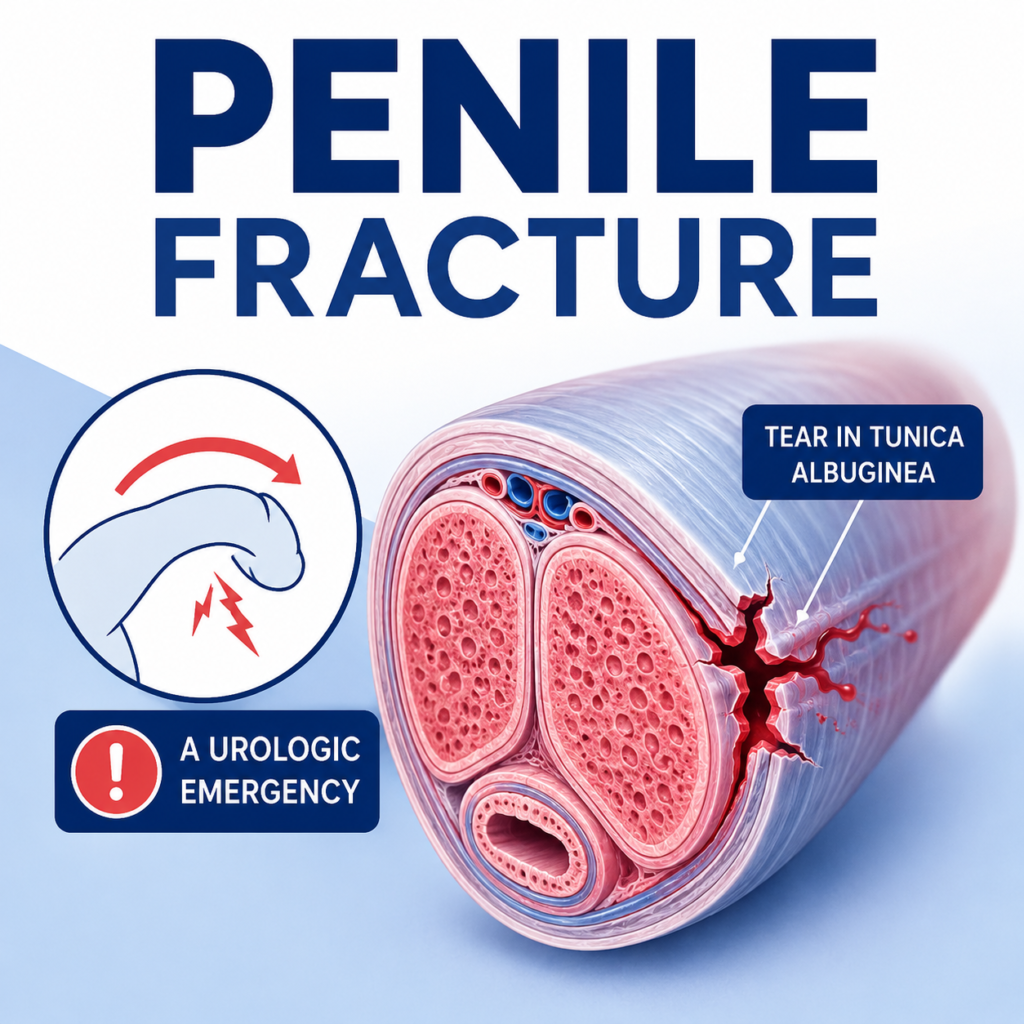
Despite its name, a penile fracture is not a broken bone because the penis contains no bones. Instead, it is a tear in the tunica albuginea, the strong fibrous tissue that surrounds the erectile chambers (corpora cavernosa).
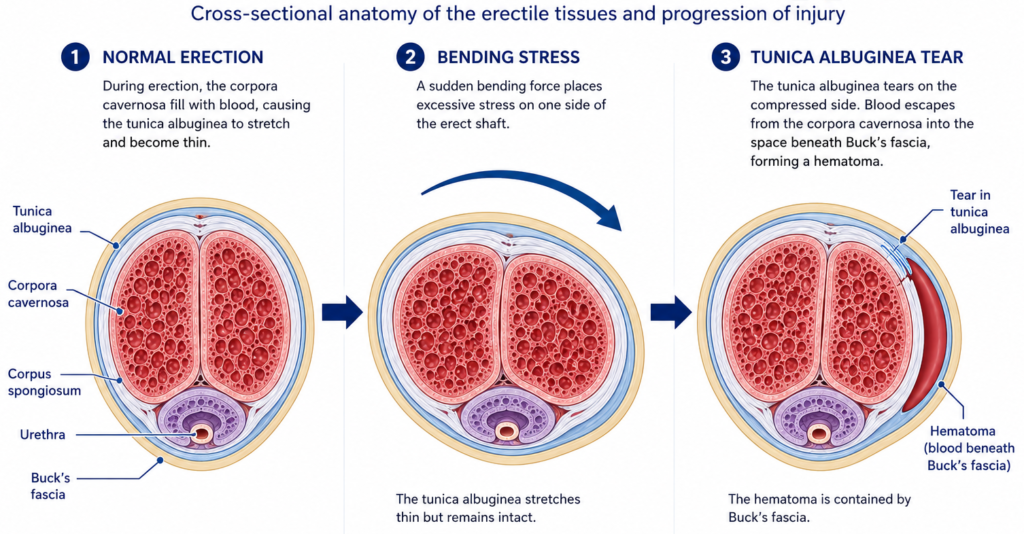
During an erection, the tunica albuginea becomes stretched and thinner. If the erect penis is suddenly bent with significant force, the tunica can tear, causing blood to escape from the erectile tissue. This often leads to immediate swelling, bruising, pain, and loss of the erection.
A penile fracture is considered a urologic emergency. Prompt evaluation and treatment, usually with surgery, provide the best chance of preserving normal erectile function and preventing long-term complications.
How Does a Penile Fracture Happen?
Most penile fractures occur during vigorous sexual activity. The injury typically happens when the erect penis slips out and forcefully strikes the partner’s pelvis or perineum instead of re-entering the vagina.
Other possible causes include:
- Aggressive masturbation
- Rolling over onto an erect penis during sleep
- Attempting to bend or forcefully conceal an erection
- Accidental blunt trauma to an erect penis
- Certain cultural practices involving intentional bending of the erect penis
The injury almost always occurs when the penis is fully erect because the tunica albuginea is stretched to its thinnest point.
Risk Factors
Certain situations increase the risk of penile fracture:
- Vigorous sexual intercourse
- Positions where thrusting is difficult to control
- Reduced visibility of penetration
- Alcohol or recreational drug use during sexual activity
- Previous penile injury or surgery
- Forceful manipulation of an erection
Although penile fracture is uncommon, it can occur in men of any adult age.
What Happens During a Penile Fracture?
During an erection, blood fills the erectile chambers, creating firmness.
When excessive bending force is applied:
- The tunica albuginea tears.
- Blood escapes into surrounding tissues.
- The erection rapidly disappears.
- Swelling and bruising develop quickly.
- Pain occurs immediately.
In some cases, the urethra, the tube that carries urine and semen, may also be injured.
Signs and Symptoms
Many patients describe a very characteristic sequence of events.
Common symptoms include:
- A sudden popping or cracking sound
- Immediate sharp pain
- Instant loss of the erection
- Rapid swelling
- Extensive bruising
- A bent or crooked appearance of the penis
- Difficulty touching the injured area due to pain
If the urethra is also injured, symptoms may include:
- Blood at the tip of the penis
- Difficulty urinating
- Inability to urinate
- Blood in the urine
The combination of a popping sound, immediate detumescence (loss of erection), swelling, and bruising strongly suggests a penile fracture.
Is Every "Pop" a Penile Fracture?
Not always.
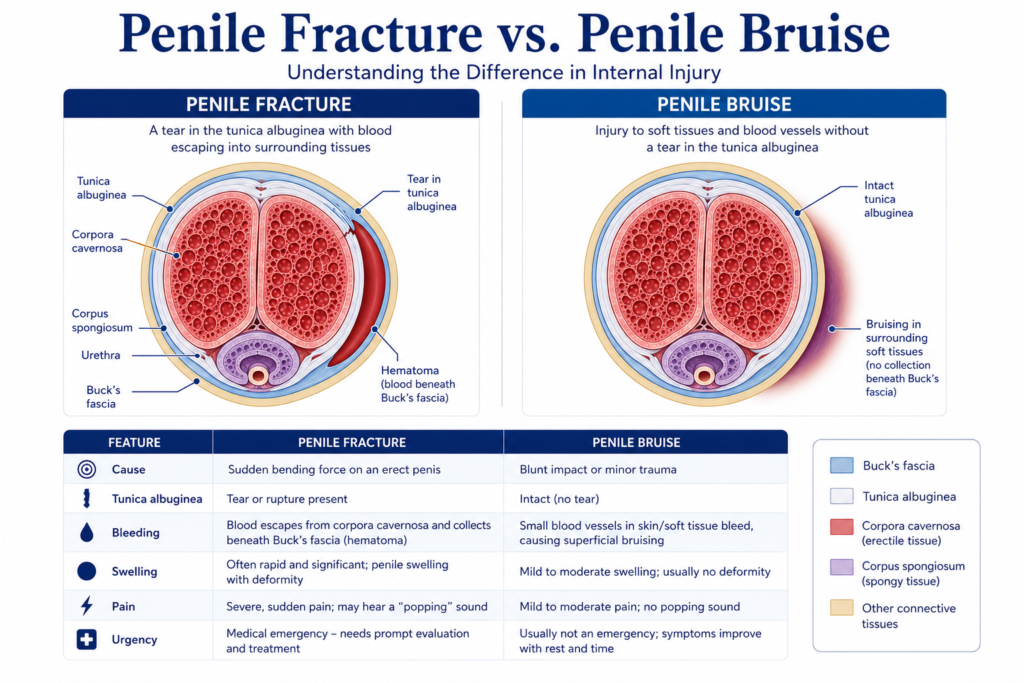
Some injuries involve rupture of superficial veins or bleeding beneath the skin without tearing the tunica albuginea.
These injuries can resemble a penile fracture but are generally less serious.
Because the symptoms may overlap, every suspected penile fracture should be evaluated promptly by a healthcare professional.
Other Conditions That Can Mimic a Penile Fracture
Several conditions may cause swelling or bruising of the penis, including:
- Ruptured superficial penile vein
- Penile hematoma
- Penile contusion (bruise)
- Penile skin injury
- Torn suspensory ligament
- Severe penile strain
Medical evaluation is necessary to determine the correct diagnosis.
How Is a Penile Fracture Diagnosed?
In many cases, the diagnosis is made based on the patient’s history and physical examination.
A healthcare provider will ask:
- How did the injury occur?
- Was the penis erect?
- Did you hear a popping sound?
- Did the erection disappear immediately?
- Are you able to urinate?
- Is there blood from the urethra?
If the diagnosis is uncertain, additional imaging may be performed.
Possible imaging tests include:
- Penile ultrasound
- Magnetic resonance imaging (MRI)
- Retrograde urethrogram if urethral injury is suspected
Not every patient requires imaging before treatment.
Treatment
Early surgical repair is considered the standard treatment for most penile fractures.
During surgery, the surgeon:
- Removes the collected blood
- Identifies the tear
- Repairs the tunica albuginea with sutures
- Repairs any urethral injury if present
Prompt surgery is associated with excellent outcomes and lower complication rates.
Is Surgery Always Necessary?
Most confirmed penile fractures require surgery.
Older approaches using ice packs, compression, medications, and observation alone have largely been replaced because conservative treatment is associated with higher rates of complications, including:
- Erectile dysfunction
- Penile curvature
- Painful erections
- Scar formation
Your urologist will determine the most appropriate treatment based on your injury.
Recovery
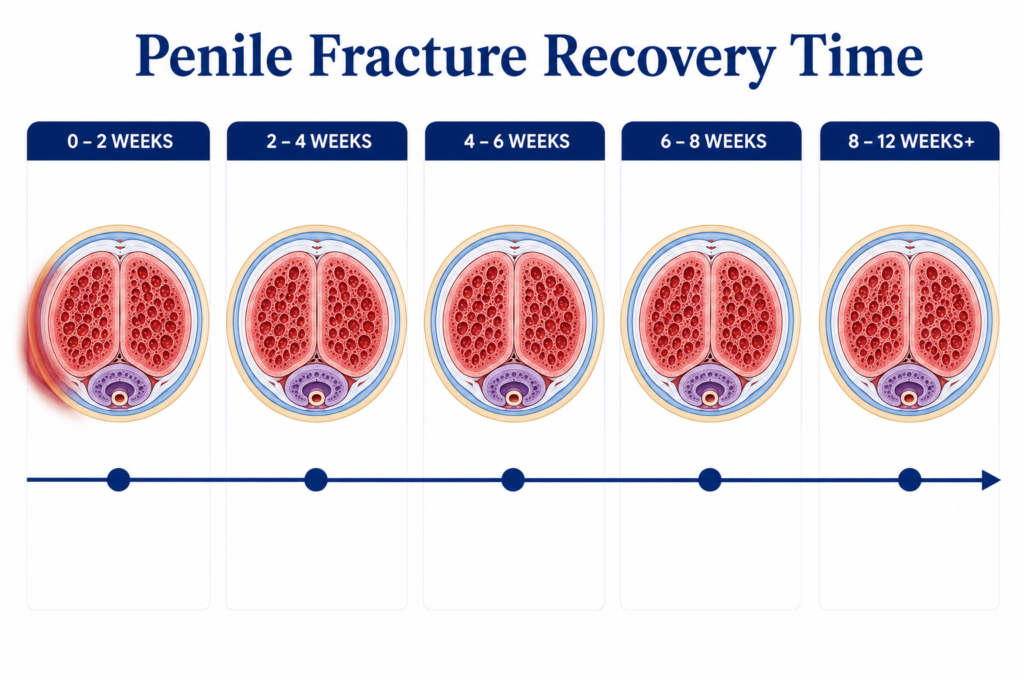
Most patients recover well after surgery.
Typical recovery includes:
First few days
- Swelling gradually improves
- Bruising begins to fade
- Pain decreases
First few weeks
- Avoid strenuous physical activity
- Avoid sexual activity
- Follow wound care instructions
Approximately 4 to 8 weeks
Many patients are able to gradually resume sexual activity after clearance from their surgeon.
Recovery times vary depending on the severity of the injury and whether the urethra was also damaged.
Possible Complications
When treated promptly, long-term complications are uncommon.
Potential complications include:
- Erectile dysfunction
- Penile curvature
- Pain during erections
- Scar tissue
- Shortening of the penis
- Persistent swelling
- Urethral stricture (if the urethra was injured)
- Pain during intercourse
Delayed treatment significantly increases the risk of these complications.
Can It Be Prevented?
Although accidents cannot always be prevented, several measures may reduce the risk:
- Avoid forcefully bending an erect penis.
- Stop sexual activity if penetration is lost.
- Resume intercourse carefully after repositioning.
- Avoid rough manipulation during masturbation.
- Seek medical attention immediately after any suspected injury.
Key Takeaways
- A penile fracture is a tear of the tunica albuginea, not a broken bone.
- Most injuries occur during sexual intercourse when the erect penis bends suddenly.
- A popping sound, immediate pain, rapid loss of erection, bruising, and swelling are classic warning signs.
- Penile fracture is a urologic emergency.
- Early surgical repair offers the best chance for complete recovery and helps prevent erectile dysfunction and penile curvature.
What Should You Do Next?
If you think you may have sustained a penile fracture, seek emergency medical care immediately. Do not wait to see if the swelling or pain improves on its own. Early diagnosis and treatment, usually with surgical repair, provide the best chance of preserving normal erectile function and preventing long-term complications.
If you are experiencing severe pain, rapid swelling, a popping sensation during an erection, or blood at the tip of the penis, go to the nearest emergency department without delay.