

Peyronie's Disease: Understanding Penile Curvature, Symptoms, and Treatment
Peyronie’s disease is a condition that causes scar tissue to develop inside the penis, leading to curvature during erections. While a slight natural curve is common and usually harmless, Peyronie’s disease can cause significant bending, pain, shortening of the penis, and difficulty with sexual activity.
Although it can feel embarrassing to discuss, Peyronie’s disease is more common than many people realize. Studies suggest it affects approximately 1% to 10% of men, although experts believe many cases go unreported because men may avoid seeking medical care.
Understanding the symptoms, causes, and available treatment options can help men recognize when it’s time to seek evaluation and prevent unnecessary anxiety.
What Is Peyronie's Disease?
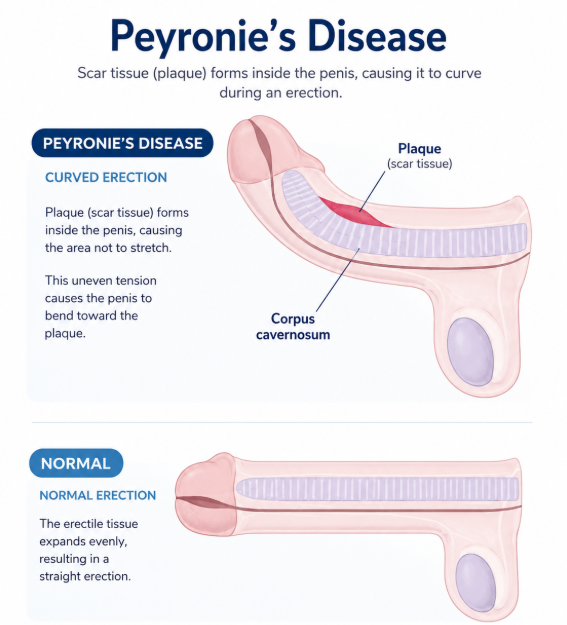
Peyronie’s disease occurs when fibrous scar tissue, called plaques, forms within the tough outer lining of the erectile tissue (tunica albuginea).
Unlike plaque found in blood vessels, these plaques are areas of hardened scar tissue that do not stretch normally. During an erection, the unaffected side of the penis expands while the scarred portion does not, causing the penis to bend toward the scar.
The amount of curvature varies widely. Some men develop only mild bending, while others experience severe deformity that interferes with sexual intercourse.
Symptoms of Peyronie's Disease
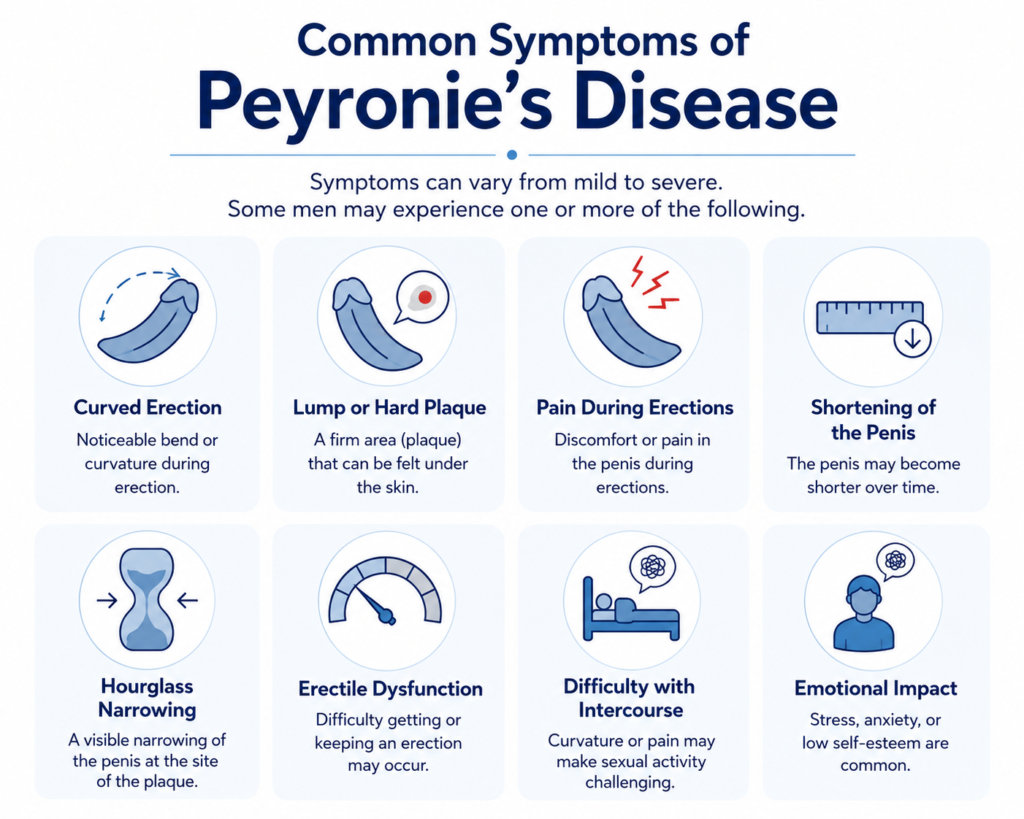
Symptoms often develop gradually and may worsen over several months before stabilizing.
Common symptoms include:
- Curved erections
- A palpable lump or hardened area within the penis
- Pain during erections
- Penile shortening
- Narrowing or an “hourglass” appearance
- Erectile dysfunction
- Difficulty having intercourse
- Emotional distress or anxiety related to sexual function
Some men notice pain early in the disease, while others primarily notice changes in shape.
What Causes Peyronie's Disease?
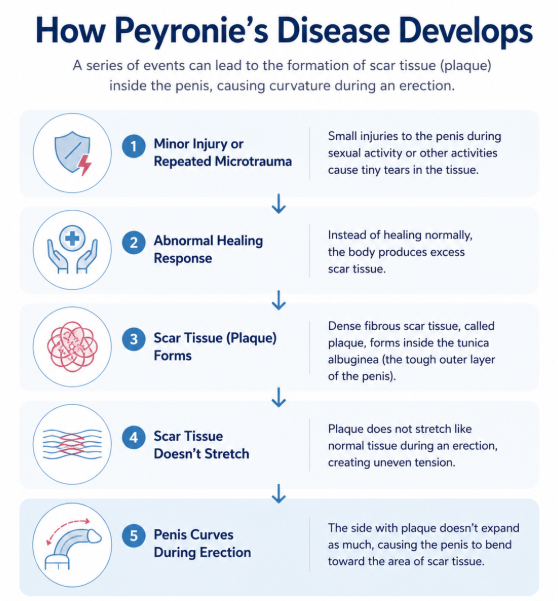
The exact cause is not always known, but experts believe repeated minor injury to the penis plays an important role.
These injuries may occur during:
- Sexual activity
- Athletic activities
- Accidental trauma
Normally, injured tissue heals without problems. In Peyronie’s disease, however, healing becomes abnormal and excess collagen forms scar tissue.
Other risk factors include:
- Increasing age
- Family history
- Certain connective tissue disorders
- Diabetes
- Erectile dysfunction
- Smoking
- Prior prostate surgery
Not every man with these risk factors develops Peyronie’s disease.
Stages of Peyronie's Disease
Peyronie’s disease generally progresses through two phases.
Acute Phase
The acute phase usually lasts between 6 and 18 months.
During this stage:
- Curvature may worsen
- Pain during erections is more common
- Scar tissue continues developing
- Penile shape may continue changing
Stable Phase
Once the disease stabilizes:
- Curvature usually stops progressing
- Pain often improves or disappears
- Scar tissue becomes stable
- Any remaining deformity typically persists unless treated
Treatment recommendations often depend on which phase the disease is in.
How Is Peyronie's Disease Diagnosed?
Diagnosis usually begins with a medical history and physical examination.
Your healthcare provider may ask about:
- When symptoms began
- Degree of curvature
- Pain
- Erectile function
- Difficulty with intercourse
- Previous penile injuries
The penis may be examined for areas of scar tissue.
Sometimes photographs taken during an erection or an ultrasound performed after medication-induced erection help determine the severity of the curvature and evaluate blood flow.
Can Peyronie's Disease Cause Erectile Dysfunction?
Yes.
Many men with Peyronie’s disease also experience erectile dysfunction.
This may occur because:
- Scar tissue interferes with normal erections.
- Curvature makes intercourse difficult.
- Anxiety or emotional stress affects sexual performance.
- Reduced penile blood flow contributes to erectile dysfunction.
Not every man with Peyronie’s disease develops erectile dysfunction.
Treatment Options
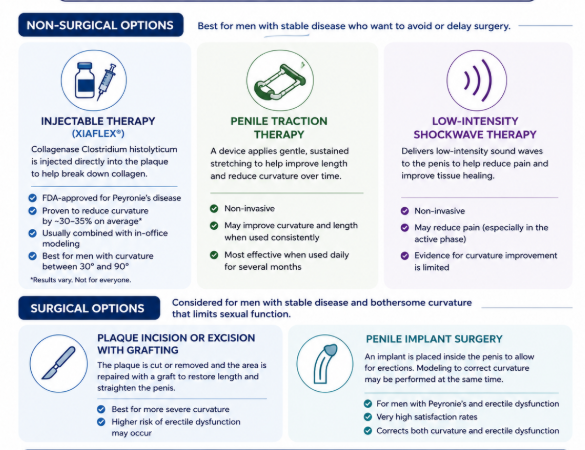
Treatment depends on symptom severity, the degree of curvature, and whether the condition is still changing.
Options may include:
Observation
Men with mild curvature and minimal symptoms may simply be monitored over time.
Penile Traction Therapy
Special traction devices may help reduce curvature and preserve penile length when used consistently over time.
Injectable Medications
For selected patients, medication injected directly into the scar tissue may help reduce curvature.
Surgery
Surgery may be considered for men with:
- Stable disease
- Significant curvature
- Difficulty with intercourse
- Severe deformity
Several surgical techniques are available depending on the individual’s condition.
Can Peyronie's Disease Go Away on Its Own?
In some men, pain improves without treatment.
However, the curvature itself is much less likely to completely resolve on its own.
Many cases stabilize rather than disappear.
Early evaluation can help determine whether treatment may improve outcomes.
When Should You See a Healthcare Provider?
Consider scheduling an evaluation if you notice:
- A new bend during erections
- A lump or hardened area in the penis
- Painful erections
- Difficulty having intercourse
- Erectile dysfunction developing with penile curvature
- Rapid worsening of symptoms
Earlier evaluation may provide more treatment options before the condition stabilizes.
Frequently Asked Questions
Is Peyronie’s disease cancer?
No. Peyronie’s disease is not cancer and does not increase the risk of penile cancer.
Is Peyronie’s disease sexually transmitted?
No. It is not caused by an infection and cannot be passed to a partner.
Can I still have sex?
Many men continue having satisfying sexual activity, particularly with mild curvature. More severe cases may make intercourse difficult or painful.
Does masturbation cause Peyronie’s disease?
There is no evidence that normal masturbation causes Peyronie’s disease.
Is surgery always necessary?
No. Many men never require surgery. Treatment depends on symptom severity and how much the condition affects quality of life.
Prognosis
Peyronie’s disease is not life-threatening, but it can significantly affect physical and emotional well-being.
Fortunately, many treatment options are available, and outcomes continue to improve as therapies evolve. Seeking evaluation early can help determine whether treatment may prevent progression or improve sexual function.
What Should You Do Next?
If you’ve noticed a new bend in your penis, pain with erections, or difficulty during sexual activity, don’t ignore the symptoms out of embarrassment. Peyronie’s disease is a recognized medical condition, and effective treatments are available for many men. A healthcare provider can evaluate your symptoms, determine whether the condition is still progressing, and discuss the most appropriate management options based on your individual situation.
References
American Urological Association. Diagnosis and Treatment of Peyronie’s Disease: AUA Guideline.
European Association of Urology. EAU Guidelines on Sexual and Reproductive Health.
Mayo Clinic. Peyronie’s disease.
Cleveland Clinic. Peyronie’s Disease.
National Institute of Diabetes and Digestive and Kidney Diseases. Peyronie’s Disease.
Mulhall JP, et al. The Journal of Sexual Medicine. Peyronie’s disease: diagnosis and management.
Nehra A, et al. American Urological Association Guideline on Peyronie’s Disease. The Journal of Urology.