
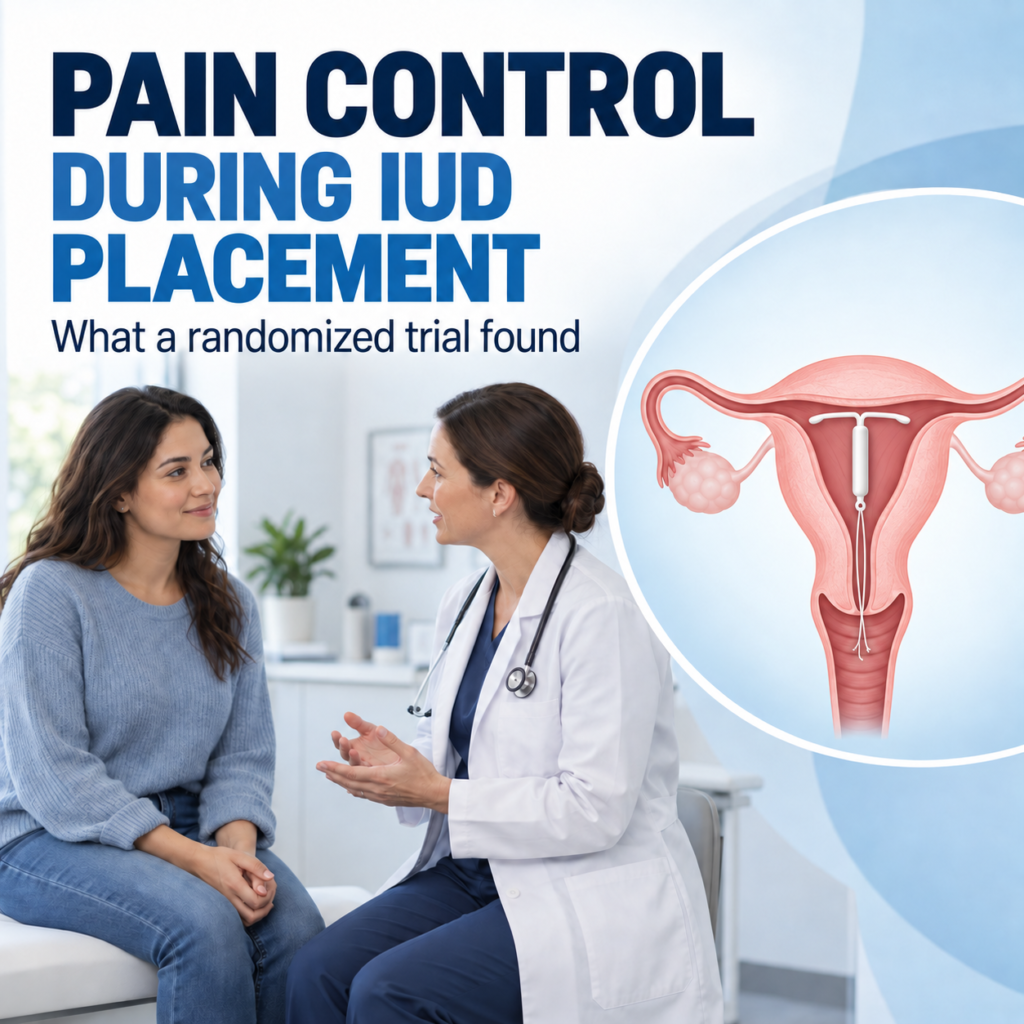
Can Mepivacaine Reduce Pain During IUD Placement?
Preview Note: A new randomized trial tested a local anesthetic approach to one of the most common concerns about choosing an IUD. The results add useful evidence, but they also raise practical questions about who may benefit and how broadly the findings apply. Estimated read time: 4 minutes.
SEO Package
SEO title: Mepivacaine for IUD Placement Pain: What a Trial Found
Primary keyword: IUD placement pain relief
Supporting keywords: mepivacaine IUD placement, IUD insertion pain, local anesthetic for IUD, randomized IUD pain trial
Slug: mepivacaine-iud-placement-pain-trial
Meta description: A randomized JAMA trial found that intrauterine mepivacaine reduced pain during IUD placement in a specific group of adults. Here is what the evidence means.
Excerpt: In a Swedish randomized trial, intrauterine mepivacaine lowered average pain scores during IUD placement. The study is promising, but it does not establish a universal protocol.
Why Pain During IUD Placement Matters
Intrauterine devices are among the most effective reversible contraceptive methods. A clinician places the small T-shaped device through the cervix and into the uterus. The procedure is usually brief, but the experience varies. Some people report mild cramping, while others describe moderate or severe pain.
Concern about pain can affect whether someone chooses an IUD. It can also shape trust and comfort during the procedure. Good counseling should take those concerns seriously, explain what to expect, and include a plan that reflects the patient's preferences, medical history, and available options.
Researchers have studied several ways to reduce placement pain, but no single approach works for everyone. The latest trial focused on mepivacaine, a local anesthetic that blocks nerve signals in a specific area.
What the Randomized Trial Tested
The study was a double-blind, randomized, placebo-controlled clinical trial conducted at 11 outpatient clinics in Sweden. It included 370 nulliparous adults, meaning participants had not previously given birth, who were 18 to 31 years old and had chosen an IUD with a smaller-diameter placement tube.
Two minutes before placement, clinicians put 10 milliliters of mepivacaine at a concentration of 20 milligrams per milliliter into the uterus. The comparison group received the same volume of saline. Random assignment and blinding strengthen the trial because they reduce the chance that differences between the groups, clinician expectations, or participant expectations explain the results.
The main outcome was pain during IUD placement, rated on a 100 millimeter visual analog scale. On that scale, a higher number means more pain.
What the Study Found
Average pain during placement was 43.8 millimeters in the mepivacaine group and 58.6 millimeters in the placebo group. After adjustment for the clinician performing the procedure, the mean difference was 14.2 millimeters. The reported 95 percent confidence interval ranged from 9.7 to 18.6 millimeters.
Participants were also asked whether the pain was tolerable. That outcome was reported by 98.3 percent of participants who received mepivacaine and 91.4 percent who received placebo. The researchers reported a number needed to treat of 15 for one additional person to describe the pain as tolerable.
These results suggest that the specific intrauterine mepivacaine protocol reduced average pain in the population studied. The findings do not mean that placement became painless, and they do not guarantee the same response for every patient.
How Strong Is the Evidence?
This is human clinical evidence from a randomized controlled trial, not a laboratory experiment, animal study, or observational association. That design makes it better suited to test whether the intervention itself caused the observed difference in pain.
Still, one trial does not settle every clinical question. Pain is subjective, and an average change can include people who experienced a large benefit, a small benefit, or no benefit. The study also tested one drug, dose, route, timing, and group of IUD devices. A different protocol may not produce the same result.
Who Was Not Represented
The participants were nulliparous adults ages 18 to 31 in Sweden. The findings may not apply in the same way to people who have previously given birth, older adults, adolescents, people undergoing IUD replacement, or patients with complex pelvic pain histories. The devices used had smaller-diameter placement tubes, so the results should not automatically be generalized to every IUD model or inserter.
The study also compared mepivacaine with saline. It did not establish that mepivacaine is better than every other pain management option, and it did not test a combination of approaches. Practical questions remain about training, availability, workflow, cost, side effects, and how easily the protocol can be used in different clinical settings.
What This Does Not Mean
Mepivacaine should not be described as making IUD placement painless. The trial does not show that it is the universal standard of care, and it is not a do-it-yourself treatment. Local anesthetics require appropriate dosing, screening, administration, and monitoring by trained clinicians.
The study measured procedural pain. It did not test whether mepivacaine changes the contraceptive effectiveness of an IUD, and it does not alter the need for individualized contraceptive counseling. Choosing an IUD involves factors such as desired duration, bleeding preferences, medical history, pregnancy prevention goals, and comfort with the placement process.
Questions Patients Can Ask
If you are considering an IUD, it is reasonable to ask how the clinic approaches pain before, during, and after placement. You can discuss prior pelvic procedures, painful examinations, anxiety, trauma history, medication allergies, and the level of support you want. Ask which pain control options are available, what evidence supports them, and what side effects or limitations to expect.
A patient-centered plan may include clear explanations, permission to pause, supportive positioning, and medication choices based on individual needs. The best plan is a shared decision, not a one-size-fits-all script.
The Bottom Line
In a randomized trial of 370 nulliparous adults ages 18 to 31, intrauterine mepivacaine given shortly before IUD placement reduced average pain compared with saline. The evidence is clinically relevant because it comes from a well-controlled human trial. It is also specific: one population, one protocol, and selected IUD devices in Swedish outpatient clinics.
The findings support continued discussion and research on better procedural pain care. They do not prove that mepivacaine is appropriate or sufficient for every person. Patients should discuss placement expectations and pain management options with a qualified clinician.
References
PubMed. Study record related to the intrauterine mepivacaine trial protocol.
Centers for Disease Control and Prevention. Contraception guidance and resources.
Centers for Disease Control and Prevention. Contraception and Birth Control Methods.
This content is for educational purposes only and is not a substitute for professional medical advice.