
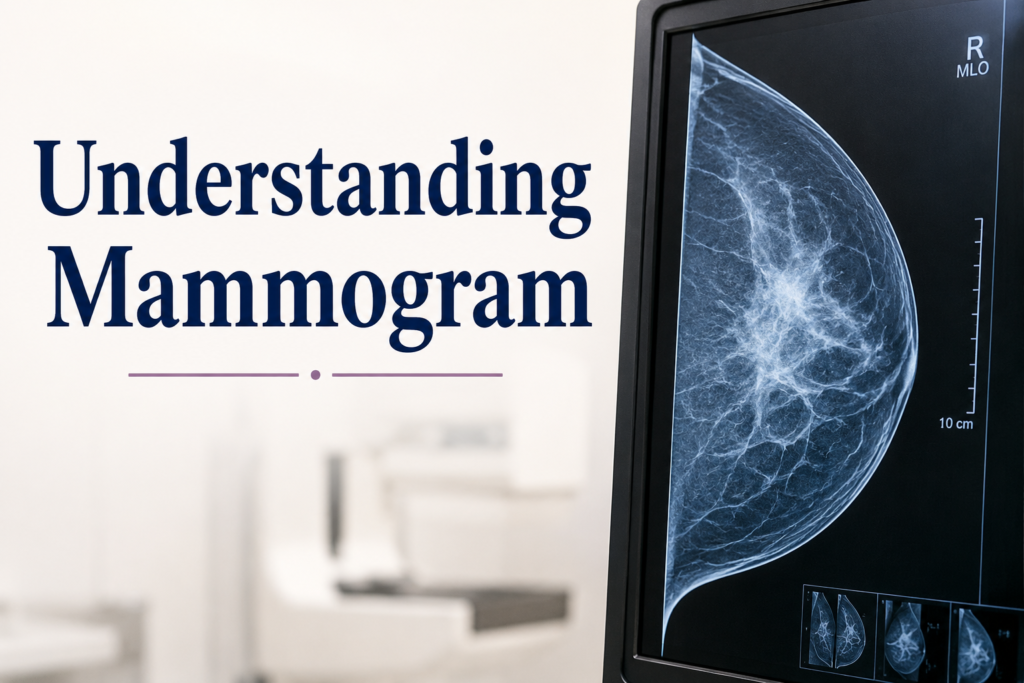
Understanding Mammograms: What They Are, What to Expect, and How to Understand Your Results
A mammogram is one of the most effective tools for detecting breast cancer early, often before a lump can be felt. Yet many women feel anxious about the procedure or are unsure when they should start screening, what the test involves, or what their results mean.
This guide explains what a mammogram is, who should get one, how to prepare, what happens during the exam, how to understand common mammogram results, and why regular screening plays an important role in breast health.
What Is a Mammogram?
A mammogram is a specialized low-dose X-ray of the breast used to detect abnormalities such as tumors, calcifications, or other changes that may not be noticeable during a physical exam.
Mammograms are used for two main purposes:
- Screening mammograms – performed in women without breast symptoms to look for early signs of breast cancer.
- Diagnostic mammograms – performed to evaluate a breast lump, persistent pain, nipple discharge, or an abnormal screening mammogram.
Early detection allows many breast cancers to be treated at an earlier stage when treatment is often simpler and outcomes are better.
Screening vs. Diagnostic Mammograms
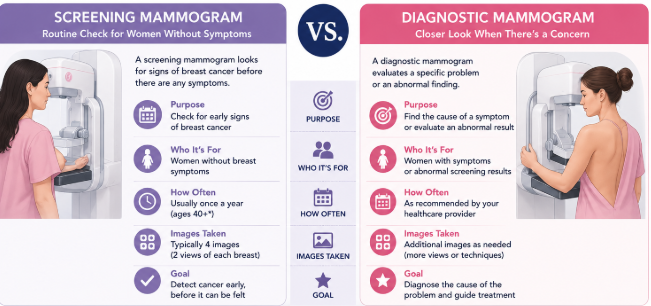
| Screening Mammogram | Diagnostic Mammogram |
|---|---|
| Routine screening | Evaluates a breast problem |
| No symptoms present | Symptoms or abnormal screening result |
| Usually four standard images | Additional images as needed |
| Shorter exam | Longer, more detailed evaluation |
Who Should Get a Mammogram?
Recommendations vary slightly among medical organizations, but screening is generally recommended based on age and individual risk factors.
| Risk Level | General Recommendation |
| Average risk | Begin regular screening around age 40, with frequency determined through shared decision-making and current guidelines |
| Higher risk | May begin earlier based on family history, genetic mutations, prior chest radiation, or other risk factors |
| Symptoms present | Diagnostic mammogram regardless of age if recommended by a healthcare professional |
Women with a strong family history or known genetic mutations such as BRCA1 or BRCA2 may require earlier screening and additional imaging, such as breast MRI.
How Does a Mammogram Work?
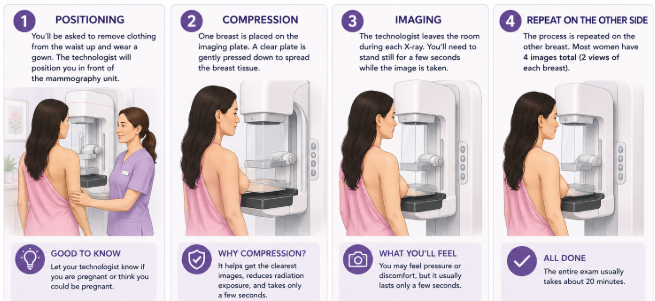
During the examination:
- One breast is placed on a flat imaging plate.
- A second plate gently compresses the breast for several seconds.
- X-ray images are taken from different angles.
- The process is repeated on the other breast.
Compression may be uncomfortable but usually lasts only a few seconds and helps produce clearer images while reducing radiation exposure.
How to Prepare for Your Mammogram
Before your appointment:
- Schedule your mammogram when your breasts are least tender, if possible.
- Do not wear deodorant, powders, lotions, or perfumes under your arms or on your breasts, as some products can appear on the images.
- Wear a two-piece outfit since you will only need to remove clothing from the waist up.
- Bring previous mammogram images if using a new imaging center.
What Happens During the Test?
The exam usually takes about 20 minutes.
Most women have four standard images:
- Two views of each breast
Additional images may be obtained if necessary.
After the exam, a radiologist interprets the images and sends a report to your healthcare professional.
Understanding Breast Density
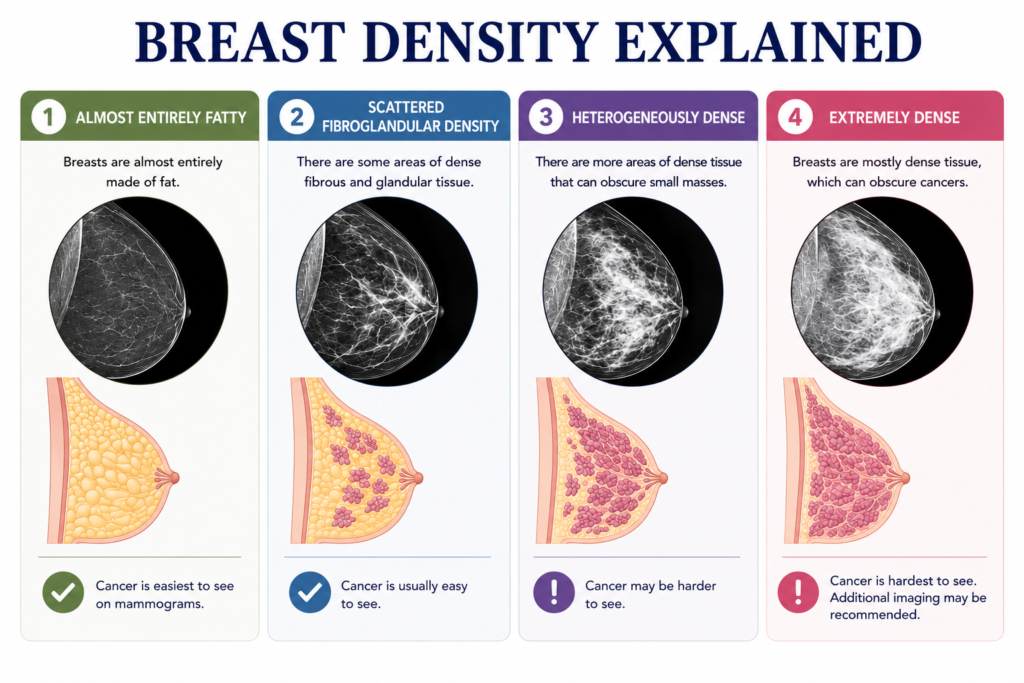
Breast density refers to the amount of fibrous and glandular tissue compared with fatty tissue on a mammogram.
Dense breasts are common and are not abnormal, but they can make it more difficult to detect certain cancers on mammography.
Breast Density Categories
| Density Category | Description |
| Almost entirely fatty | Mostly fatty tissue |
| Scattered fibroglandular density | Small areas of dense tissue |
| Heterogeneously dense | More dense tissue that may obscure small abnormalities |
| Extremely dense | Very dense breast tissue, making interpretation more challenging |
Women with dense breasts may benefit from additional imaging depending on their overall breast cancer risk and local screening recommendations.
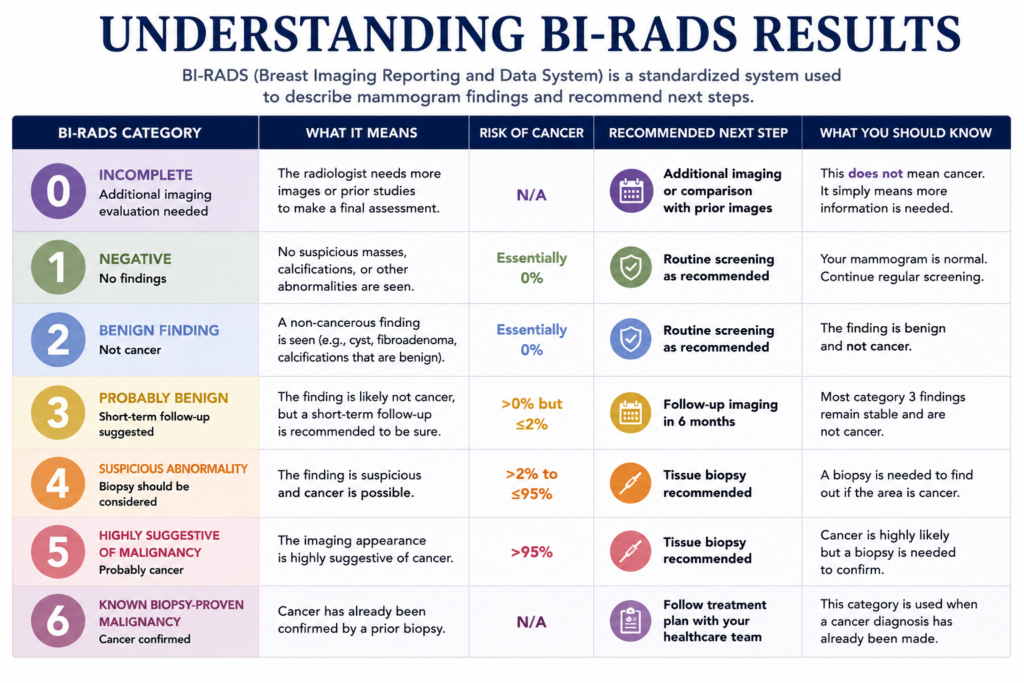
Most mammogram reports include a BI-RADS category.
A BI-RADS 0 result does not mean cancer. It simply means that additional imaging is needed before a final interpretation can be made.
What Can a Mammogram Detect?
A mammogram may identify:
- Breast masses
- Microcalcifications
- Architectural distortion
- Asymmetry
- Cysts (sometimes with ultrasound)
- Early breast cancers
Not every abnormal finding represents cancer.
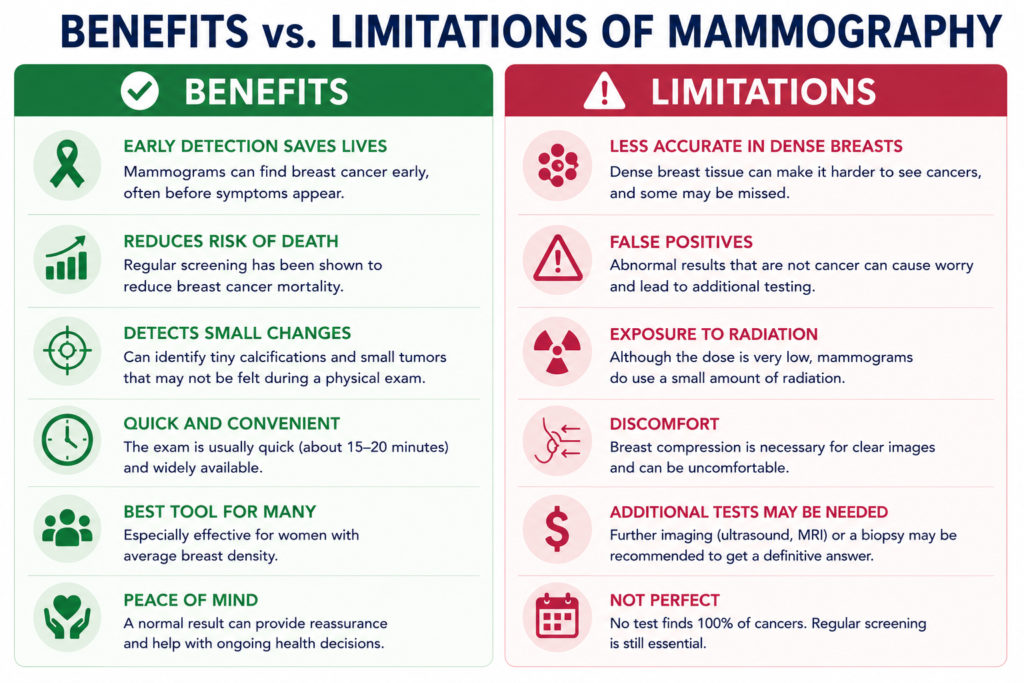
Benefits of Mammography
Regular screening mammography can:
- Detect cancer before symptoms develop
- Identify smaller, earlier-stage cancers
- Reduce breast cancer mortality
- Decrease the need for more extensive treatment when cancer is found early
Limitations of Mammograms
No screening test is perfect.
Limitations include:
- False-positive results
- False-negative results
- Additional imaging may sometimes be required
- Dense breast tissue can make interpretation more difficult
Because of these limitations, mammograms should be considered one part of an overall breast health strategy.
What If My Mammogram Is Abnormal?
An abnormal mammogram does not automatically mean breast cancer.
Depending on the findings, your healthcare professional may recommend:
- Additional mammogram views
- Breast ultrasound
- Breast MRI
- Short-term follow-up imaging
- Breast biopsy
Many abnormal mammograms ultimately prove to be benign.
Possible Risks
Mammography is considered very safe.
Potential risks include:
- Minimal radiation exposure
- Temporary discomfort from breast compression
- Anxiety related to additional testing
- False-positive or false-negative results
For most women, the benefits of screening greatly outweigh these risks.
When Should You Seek Medical Attention?
Schedule an evaluation promptly if you notice:
☐ A new breast lump
☐ Bloody or spontaneous nipple discharge
☐ Skin dimpling
☐ New nipple inversion
☐ Persistent breast swelling
☐ Redness or warmth that does not improve
☐ Persistent one-sided breast pain
Even if your recent mammogram was normal, new breast symptoms should always be evaluated.
What Should You Do Next?
A mammogram is one of the most effective tools for detecting breast cancer early, often before symptoms develop. Understanding what the test can—and cannot—show helps reduce anxiety and allows you to make informed decisions about your breast health. If you’re due for screening or have noticed a new breast symptom, talk with your healthcare professional about the imaging that’s right for you.
References
American College of Radiology. ACR Appropriateness Criteria®: Breast Cancer Screening.
American Cancer Society. Breast Cancer Screening Guidelines.
U.S. Preventive Services Task Force. Breast Cancer: Screening.
National Comprehensive Cancer Network (NCCN). Breast Cancer Screening and Diagnosis Guidelines.
Society of Breast Imaging. Breast Density and Supplemental Screening.
American College of Obstetricians and Gynecologists (ACOG). Practice Bulletin: Breast Cancer Risk Assessment and Screening in Average-Risk Women.
Mayo Clinic. Mammogram.
UpToDate. Screening for Breast Cancer: Strategies and Recommendations.