
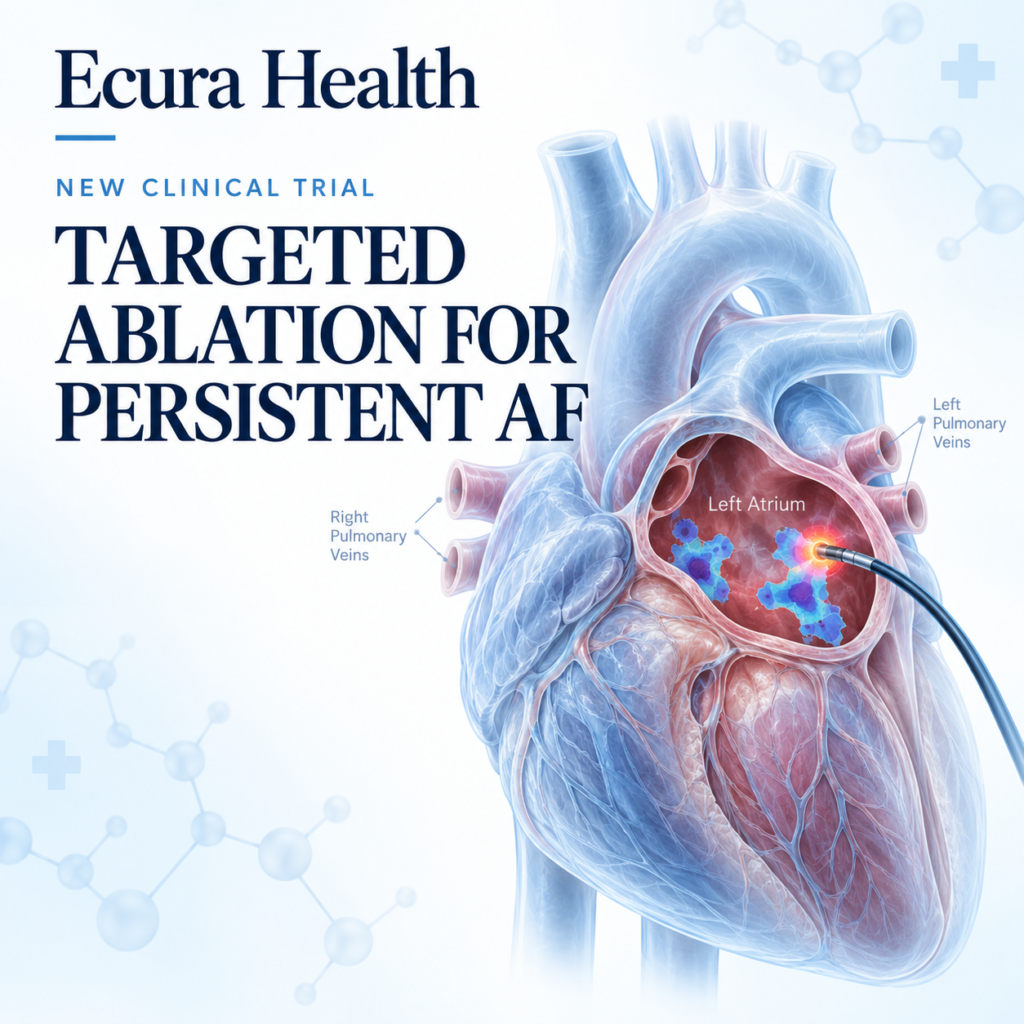
A randomized trial tested a map-guided strategy beyond pulmonary vein isolation in a defined subgroup.
A More Personalized Ablation Strategy Shows Promise
A randomized clinical trial published online in JAMA on August 30, 2026, found that adding individualized ablation of low-voltage areas to pulmonary vein isolation improved rhythm outcomes in selected adults undergoing a first ablation for persistent atrial fibrillation.
The key word is selected. The trial enrolled people whose heart mapping showed significant low-voltage zones in the left atrium. It does not establish that every person with atrial fibrillation should receive more extensive ablation.
What Is Persistent Atrial Fibrillation?
Atrial fibrillation, or AF, is an abnormal heart rhythm that begins in the upper chambers of the heart. Electrical activity becomes disorganized, and the atria do not contract in a coordinated way. Some people notice palpitations, shortness of breath, fatigue, dizziness, or reduced exercise tolerance; others have few symptoms.
Persistent AF generally lasts longer than seven days or requires treatment to restore a normal rhythm. It can be more difficult to treat than shorter, self-terminating episodes because electrical and structural changes may become established in the atria.
AF also increases the risk of stroke. Rhythm treatment and stroke prevention are related but separate decisions. A successful ablation does not automatically eliminate the need for anticoagulation.
What Does Standard Ablation Do?
Catheter ablation uses thin tubes passed through blood vessels to the heart. Energy is delivered to small areas of tissue to interrupt electrical signals that sustain the abnormal rhythm.
Pulmonary vein isolation, or PVI, is the foundation of AF ablation. It creates lesions around the pulmonary veins to prevent triggers from entering the left atrium. PVI can be effective, but recurrence is common in persistent AF, and researchers have continued to study whether additional targets improve outcomes.
What Are Low-Voltage Zones?
During an ablation procedure, clinicians can create an electroanatomical map of the atrium. Areas producing lower electrical voltage may serve as a marker of diseased or fibrotic atrial tissue, although voltage is an imperfect surrogate and can be influenced by rhythm and mapping technique.
Such tissue may support slow, uneven electrical conduction that helps AF continue. The theory behind low-voltage-zone ablation is that treating selected abnormal areas, in addition to isolating the pulmonary veins, may reduce the electrical substrate that maintains the arrhythmia.
Previous studies of extra ablation beyond PVI have produced mixed results. That uncertainty is why a randomized comparison of an individualized, map-guided strategy is important.
How the IDEAL-AF Trial Was Designed
The IDEAL-AF trial was conducted at five ablation centers in Sweden. Investigators mapped 936 adults undergoing a first procedure for persistent AF. Of those, 209 had significant low-voltage zones measuring at least 3 square centimeters and were randomly assigned to treatment.
All participants received pulmonary vein isolation. In the intervention group, 102 people also received individualized ablation of their mapped low-voltage zones. The 107 people in the comparison group received PVI alone.
Participants had a median age of 72 years, and 52.2% were women. Follow-up lasted 12 months. The primary outcome was freedom from documented atrial arrhythmia without antiarrhythmic drugs after one or two ablation procedures performed within the first six months.
What Did the Trial Find?
At 12 months, 67.6% of participants assigned to PVI plus low-voltage-zone ablation met the primary outcome, compared with 37.4% assigned to PVI alone. The absolute difference was 30.3 percentage points and was statistically significant.
Results after a single procedure also favored the individualized strategy, and health-related quality of life improved more in the low-voltage-zone group.
Serious adverse events occurred in 9.8% of the additional-ablation group and 7.5% of the PVI-only group. The difference was not statistically significant, but that does not mean additional ablation is risk-free or that the trial could exclude every meaningful safety difference.
What the Results Mean
For patients with persistent AF and sufficiently large low-voltage zones found during mapping, treating those areas in addition to PVI improved the likelihood of remaining free from documented atrial arrhythmia during the first year.
The study supports a more individualized approach: map the atrium, identify whether an abnormal substrate is present, and tailor additional treatment to that pattern rather than applying the same extra lesion set to everyone.
The findings may influence discussions between electrophysiologists and selected patients, but they do not make low-voltage-zone ablation a universal requirement.
Important Limitations
Only 209 of 936 mapped patients entered the randomized comparison because they met the low-voltage-zone criterion. The result therefore applies to a minority subgroup with persistent AF and significant mapped abnormalities.
The trial took place at five Swedish centers with experienced teams, and follow-up was 12 months. Longer-term durability, reproducibility across a wider range of centers, effects on hospitalization or survival, and the best mapping and lesion techniques remain important questions.
The primary outcome allowed one or two procedures within six months. The percentages should not be interpreted as the success rate of one procedure in every patient. The trial also measured documented rhythm recurrence; no monitoring method can guarantee detection of every brief or asymptomatic episode.
Ablation Does Not Replace Stroke Prevention
The decision to use an anticoagulant is based largely on a person’s stroke risk, not only on whether the heart rhythm appears normal after ablation. Age, prior stroke or transient ischemic attack, heart failure, high blood pressure, diabetes, and vascular disease may influence that risk.
Patients should not stop an anticoagulant or antiarrhythmic medication after ablation unless the prescribing clinician recommends it. A lower symptom burden or a quiet monitor does not by itself prove that stroke risk has disappeared.
Questions to Ask an Electrophysiologist
Patients considering ablation can ask how persistent their AF is, what symptoms and goals are driving the procedure, how the center performs voltage mapping, whether low-voltage zones would change the plan, what risks come with additional lesions, and how rhythm will be monitored afterward.
It is also reasonable to ask about the chance of needing a repeat procedure, medication plans after ablation, and how stroke-prevention decisions will be made.
The Bottom Line
In the IDEAL-AF randomized trial, adding individualized ablation of significant low-voltage zones to pulmonary vein isolation improved 12-month rhythm control and quality of life in selected adults with persistent atrial fibrillation.
The study does not show that all people with AF need additional ablation, that the procedure cures AF, or that anticoagulation can be stopped. The result is best understood as evidence for a promising, map-guided strategy in a defined population, with longer-term and broader real-world evidence still needed.
This content is for educational purposes only and is not a substitute for professional medical advice.