
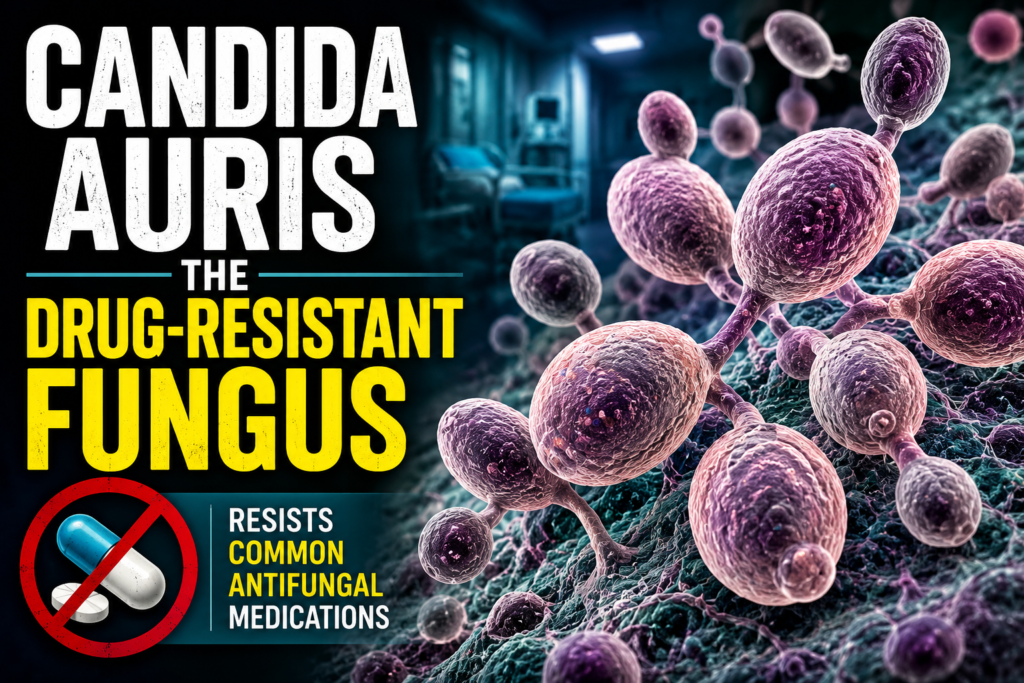
You may have seen reports about a fungus called Candida auris, or C. auris, spreading in healthcare facilities and becoming increasingly resistant to antifungal medications.
That can sound alarming, especially because Candida is also the name of the yeast associated with common conditions such as vaginal yeast infections and oral thrush.
But Candida auris is different.
C. auris is an emerging type of yeast that primarily affects people who are already seriously ill or receiving complex medical care. It can spread between patients in healthcare facilities, survive on surfaces for long periods, and resist some of the medications normally used to treat fungal infections.
For most healthy people living in the community, the risk of developing a serious C. auris infection remains low.
What Is Candida Auris?
Candida auris is a type of yeast first identified in 2009. Since then, it has emerged in countries around the world, including the United States.
The Centers for Disease Control and Prevention considers C. auris an important public health concern because it:
Can cause serious infections
Spreads easily in healthcare facilities
Can survive on surfaces for long periods
Is often resistant to antifungal medications
Can sometimes be difficult for laboratories to identify
Can colonize people without causing symptoms
The combination of these characteristics makes C. auris particularly challenging for hospitals, nursing facilities and other healthcare environments.
Is Candida Auris the Same as a Vaginal Yeast Infection?
No.
Although both involve organisms belonging to the Candida group, Candida auris should not be confused with the Candida species that commonly cause vaginal yeast infections.
A typical vaginal yeast infection may cause itching, irritation and vaginal discharge and is commonly associated with species such as Candida albicans.
C. auris, on the other hand, is primarily a concern in healthcare environments and can cause serious invasive infections in medically vulnerable patients.
Having an ordinary vaginal yeast infection does not mean that you have Candida auris.
Who Is Most at Risk?
Most healthy people are not considered at high risk for serious C. auris infection.
People at greater risk generally have significant medical problems or require extensive healthcare.
Risk factors include:
Being hospitalized for an extended period
Living in certain long-term healthcare facilities
Having a weakened immune system
Requiring mechanical ventilation
Having a central venous catheter or other invasive medical device
Requiring complex medical care
Frequent or prolonged healthcare facility stays
The use of broad-spectrum antibiotics and antifungal medications has also been associated with C. auris infection and colonization.
What Does It Mean to Be Colonized With Candida Auris?
This is an important distinction.
Someone can have C. auris on their body without being sick.
This is called colonization.
A colonized person does not necessarily have an infection and may have no symptoms at all. However, the organism can remain on the person’s skin or other body sites and can potentially spread to surfaces or other vulnerable patients.
Colonization can persist for a long time.
Because of this, healthcare facilities may continue using special infection-control precautions even after someone has recovered from an active C. auris infection.
There is currently no established treatment for simply removing C. auris colonization from the body.
How Does Candida Auris Spread?
C. auris is particularly good at surviving in healthcare environments.
It can spread through contact with:
Contaminated healthcare equipment
Bedrails
Doorknobs
Other contaminated surfaces
Objects used during patient care
Potentially the hands of healthcare personnel if appropriate infection-control practices are not followed
The organism can survive on surfaces for extended periods.
This ability to persist in the environment is one reason healthcare facilities use specific disinfectants and infection-control procedures when caring for someone who has C. auris.
What Are the Symptoms?
There is no single set of symptoms that identifies a Candida auris infection.
Symptoms depend on where the infection occurs.
C. auris can infect areas such as:
The bloodstream
Wounds
The ears
Other parts of the body
A serious bloodstream infection may cause symptoms such as:
Fever
Chills
Low blood pressure
General signs of severe infection
However, these symptoms can occur with many bacterial and fungal infections.
This is why laboratory testing is necessary to determine whether C. auris is responsible.
Why Is Candida Auris Difficult to Treat?
One of the biggest concerns surrounding C. auris is antifungal resistance.
Antifungal medications are used to treat fungal infections in much the same way antibiotics are used to treat bacterial infections.
But fungi can develop resistance to these medications.
According to the CDC, more than 90% of U.S. C. auris samples are resistant to fluconazole, a commonly used antifungal medication.
Most C. auris infections can still be treated with another group of antifungal medications called echinocandins.
However, echinocandin-resistant infections are increasing.
Even more concerning, some strains have developed resistance to all three major classes of antifungal medications.
These are sometimes called pan-resistant strains.
Fortunately, these highly resistant infections remain uncommon.
How Is Candida Auris Treated?
Treatment depends on whether someone actually has an infection.
The CDC generally recommends an echinocandin antifungal medication as initial treatment for most adults with a clinical C. auris infection.
Doctors may also perform antifungal susceptibility testing to determine which medications are most likely to work against a particular strain.
Treatment can become more complicated when the organism is resistant to echinocandins or multiple classes of antifungal medications.
Importantly, people who are simply colonized with C. auris generally should not receive antifungal treatment if they do not have signs or symptoms of infection.
Why Are Cases Increasing?
C. auris was not identified until 2009 and has since spread internationally.
The United States identified its first cases in 2016.
Since then, reported cases have increased considerably. According to CDC surveillance data, 6,304 clinical cases were reported in the United States in 2024.
The increase is concerning because C. auris can spread within healthcare facilities and because resistant strains can potentially spread from one patient to another.
Public health agencies therefore closely monitor cases, particularly clusters occurring in hospitals and long-term-care facilities.
Should Healthy People Be Worried?
For most healthy people, C. auris is not an everyday infection risk.
It is not spreading through communities in the same way as respiratory viruses such as influenza or COVID-19.
The greatest concern involves medically vulnerable people who spend significant amounts of time in healthcare facilities, particularly those requiring invasive devices or complex medical care.
Healthy family members and healthcare workers are generally at very low risk of developing an infection.
What If You’ve Previously Had Candida Auris?
If you’ve previously tested positive for C. auris, either through infection or colonization, tell healthcare professionals when receiving medical care in the future.
This is important even if:
Your infection was successfully treated
You currently feel well
The positive test occurred months or years ago
People can remain colonized for prolonged periods.
Knowing about a previous positive result allows hospitals and other healthcare facilities to use appropriate precautions to reduce the chance of spreading the organism to other vulnerable patients.
Can Candida Auris Be Prevented?
Preventing C. auris primarily depends on strong infection-control practices within healthcare facilities.
Important measures include:
Proper hand hygiene
Appropriate cleaning and disinfection
Screening certain high-risk patients
Using recommended precautions for infected or colonized patients
Proper handling of shared medical equipment
Appropriate use of antibiotics and antifungal medications
Patients and visitors can also help by practicing good hand hygiene, particularly when entering and leaving healthcare environments.
What Should You Do Next?
Seeing headlines about a rapidly spreading, drug-resistant fungus can be frightening, but context matters.
C. auris is a serious and growing public health concern because it can cause difficult-to-treat infections and spread efficiently within healthcare facilities.
However, most healthy people living in the community are at low risk.
The people most vulnerable are generally already seriously ill, hospitalized, living in certain long-term-care environments, or dependent on invasive medical devices.
If you or a family member has previously tested positive for Candida auris, make sure future healthcare teams know about the result. If you’re caring for someone in a healthcare facility, regular hand hygiene remains one of the simplest ways to help reduce the spread of infectious organisms.