
Facial Wrinkles: Causes, Prevention, Treatment, and What Really Works
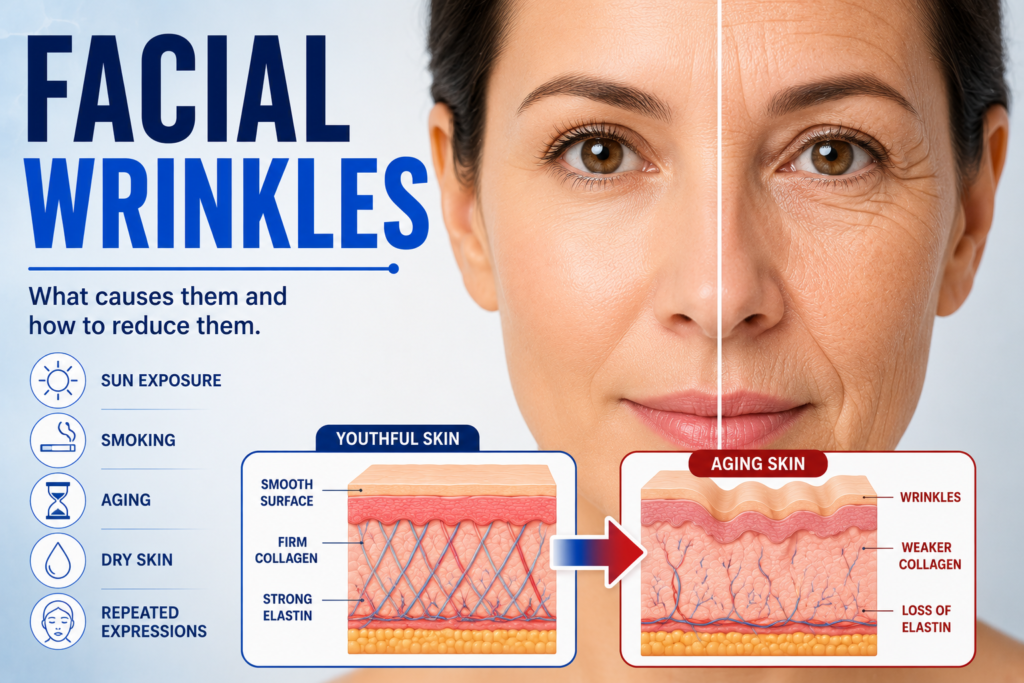
What Are Facial Wrinkles?
Facial wrinkles are lines, folds, and creases that develop in the skin over time.
They occur because the skin gradually loses collagen, elastin, and moisture as we age. Repeated facial expressions, gravity, and years of sun exposure also contribute to wrinkle formation.
Wrinkles commonly appear on the:
- Forehead
- Around the eyes (crow’s feet)
- Between the eyebrows
- Around the mouth
- Neck
Common Signs
You may notice:
- Fine lines that appear with facial expressions
- Deeper wrinkles that remain visible at rest
- Crow’s feet around the eyes
- Forehead lines
- Smile lines (nasolabial folds)
- Loss of skin firmness or elasticity
Wrinkles usually become more noticeable with age but can appear earlier in people with significant sun exposure or who smoke.
Facial Wrinkles at a Glance
| Fine Lines | Deeper Wrinkles |
|---|---|
| Usually appear in your 20s or 30s | More common after age 40 |
| Visible mainly with facial expressions | Visible even when the face is relaxed |
| Often respond well to skin care | May require cosmetic procedures for greater improvement |
| Usually shallow | More pronounced skin folds |
Did You Know?
Up to 80% of visible skin aging is caused by ultraviolet (UV) exposure rather than natural aging alone. Wearing sunscreen every day is one of the most effective ways to slow premature wrinkle formation.
What Causes Facial Wrinkles?
Several factors contribute to wrinkle development.
Common causes include:
- Natural aging
- Sun (UV) exposure
- Smoking
- Repeated facial expressions
- Dry skin
- Air pollution
- Genetics
- Loss of collagen and elastin
- Poor sleep
- Dehydration
Most people develop wrinkles because of a combination of these factors.
Who Is More Likely to Develop Wrinkles?
Your risk increases if you:
- Spend significant time in the sun
- Use tanning beds
- Smoke
- Have fair skin
- Do not use sunscreen regularly
- Have a family history of premature skin aging
How Can Facial Wrinkles Be Treated?
Treatment depends on the severity of the wrinkles and your cosmetic goals.
| Treatment | How It Helps |
| Daily sunscreen | Helps prevent new wrinkles |
| Moisturizers | Improve skin hydration and temporarily reduce the appearance of fine lines |
| Retinol or prescription retinoids | Stimulate collagen production and improve fine lines |
| Botox® | Relaxes facial muscles that create expression lines |
| Dermal fillers | Restore lost volume and soften deeper wrinkles |
| Laser resurfacing | Improves skin texture and stimulates collagen |
| Microneedling | Promotes new collagen formation |
No treatment permanently removes wrinkles, and maintenance treatments are often needed.
How Can You Help Prevent Wrinkles?
Daily habits can slow premature skin aging.
- Wear a broad-spectrum sunscreen with SPF 30 or higher every day.
- Avoid tanning beds.
- Wear sunglasses and a wide-brimmed hat outdoors.
- Don’t smoke.
- Moisturize your skin regularly.
- Eat a balanced diet rich in fruits and vegetables.
- Get enough sleep.
- Stay hydrated.
Consistent sun protection provides the greatest long-term benefit.
Myths vs. Facts
| Myth | Fact |
| Wrinkles are caused only by aging. | Sun exposure is one of the biggest causes of premature wrinkles. |
| Expensive creams erase deep wrinkles. | Most creams improve the appearance of fine lines but cannot eliminate deep wrinkles. |
| Sunscreen is only needed on sunny days. | UV rays reach your skin even on cloudy days. |
| Smoking only affects the lungs. | Smoking accelerates skin aging and wrinkle formation. |
When Should You See a Healthcare Provider?
Consider seeing a healthcare provider or dermatologist if you:
- Develop wrinkles much earlier than expected
- Notice rapidly changing skin texture
- Have skin growths or lesions along with wrinkles
- Want to discuss prescription skin care or cosmetic treatments
- Have concerns about skin cancer or sun damage
Frequently Asked Questions
At what age do wrinkles usually start?
Fine lines often begin appearing in your late 20s or 30s, while deeper wrinkles become more common after age 40.
Does retinol really work?
Yes. Retinol and prescription retinoids have been shown to improve fine lines and stimulate collagen production when used consistently.
Is Botox permanent?
No. Botox typically lasts about three to four months before repeat treatment is needed.
What is the best way to prevent wrinkles?
Daily sunscreen use, avoiding smoking, and using a retinoid when appropriate are among the most effective ways to reduce premature skin aging.
What Should You Do Next?
Wrinkles are a natural part of aging, but healthy skin care habits can make a meaningful difference. Daily sunscreen, gentle skin care, and avoiding smoking can help slow the development of new wrinkles. If you’re interested in improving existing wrinkles, a dermatologist can discuss treatments ranging from prescription retinoids to cosmetic procedures based on your goals.
References
American Academy of Dermatology Association. Wrinkle Remedies: How to Reduce the Signs of Aging
https://www.aad.org/public/everyday-care/skin-care-secrets/anti-aging/wrinkle-remedies
American Academy of Dermatology Association. Retinoid or Retinol?
https://www.aad.org/public/everyday-care/skin-care-secrets/anti-aging/retinoid-retinol
Mayo Clinic. Wrinkles: Symptoms and Causes
https://www.mayoclinic.org/diseases-conditions/wrinkles/symptoms-causes/syc-20354927
Mayo Clinic. Wrinkles: Diagnosis and Treatment
https://www.mayoclinic.org/diseases-conditions/wrinkles/diagnosis-treatment/drc-20354931
Cleveland Clinic. Wrinkles
https://my.clevelandclinic.org/health/diseases/10984-wrinkles
Cleveland Clinic. How to Get Rid of Wrinkles: Retinol, Fillers & Other Treatments
https://my.clevelandclinic.org/health/treatments/8411-treatments-to-reduce-wrinkles